UNFAIR
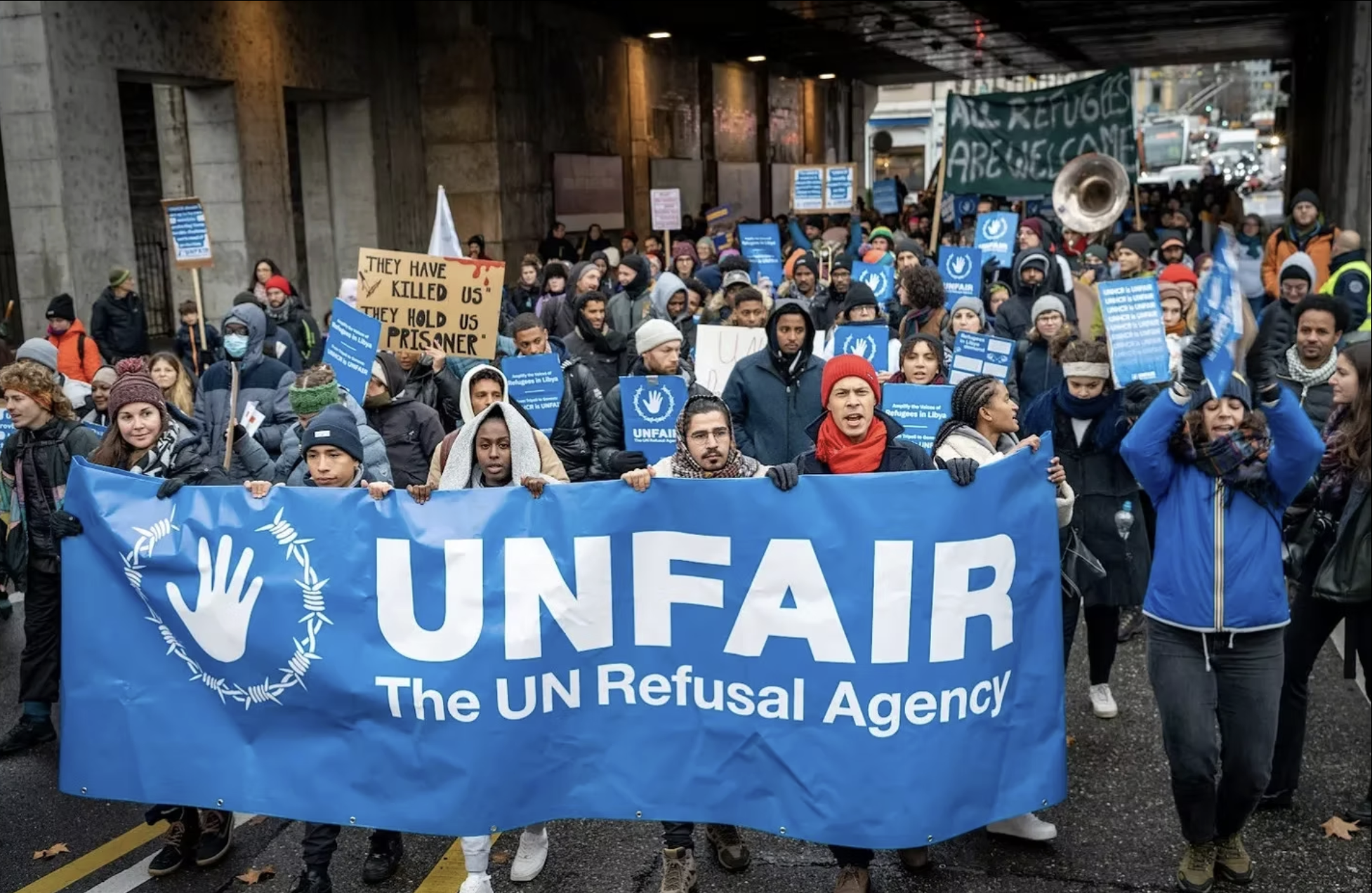
UNHCR is UNFAIR
The campaign "UNFAIR - The UN Refusal Agency" criticises the work of the United Nations Refugee Agency (UNHCR), particularly in Libya. Instead of fulfilling its mandate to protect refugees, asylum seekers, and people on the move, the UNHCR is protecting European borders and has become an instrument of European externalisation policies.
Testlink
Protecting refugees or protecting borders?
Based on the 19511 Geneva 2Refugee Convention, the core mandate of the United Nations Refugee Agency (UNHCR) lies in ensuring the protection of refugees, returnees, and stateless people worldwide. The UN agency, initially founded during the aftermath of Second World War, was created to help millions of Europeans who were forced to flee or had lost their homes.
While the number of forcibly displaced people has been growing ever since UNHCR’s foundation, its actual work has become increasingly state-oriented, making UNHCR ever more part of states’ containment and management policies and diluting its mandate of being a strong voice for refugees.
In reality, UNHCR has become part of a “global police of populations”, managing migration with states’ money and defending and strengthening a capitalist and racist border regime based on colonial continuities.
UNHCR is chronically and severely underfunded. Approximately 85% of its funding comes from individual states and the European Union (EU). Each year, UNHCR only receives around 50% of the money actually needed to fulfil its mandate. The constant lack of financial resources contributes to UNHCR’s state dependency, especially with regards to big donors such as European member states. This vulnerability also leads to UNHCR staying increasingly silent in the light of deadly European migration policies and border crimes. However, we refuse to accept UNHCR’s alleged ‘neutral silence’. Remaining silent in the light of injustices is tantamount with being complicit. 3
4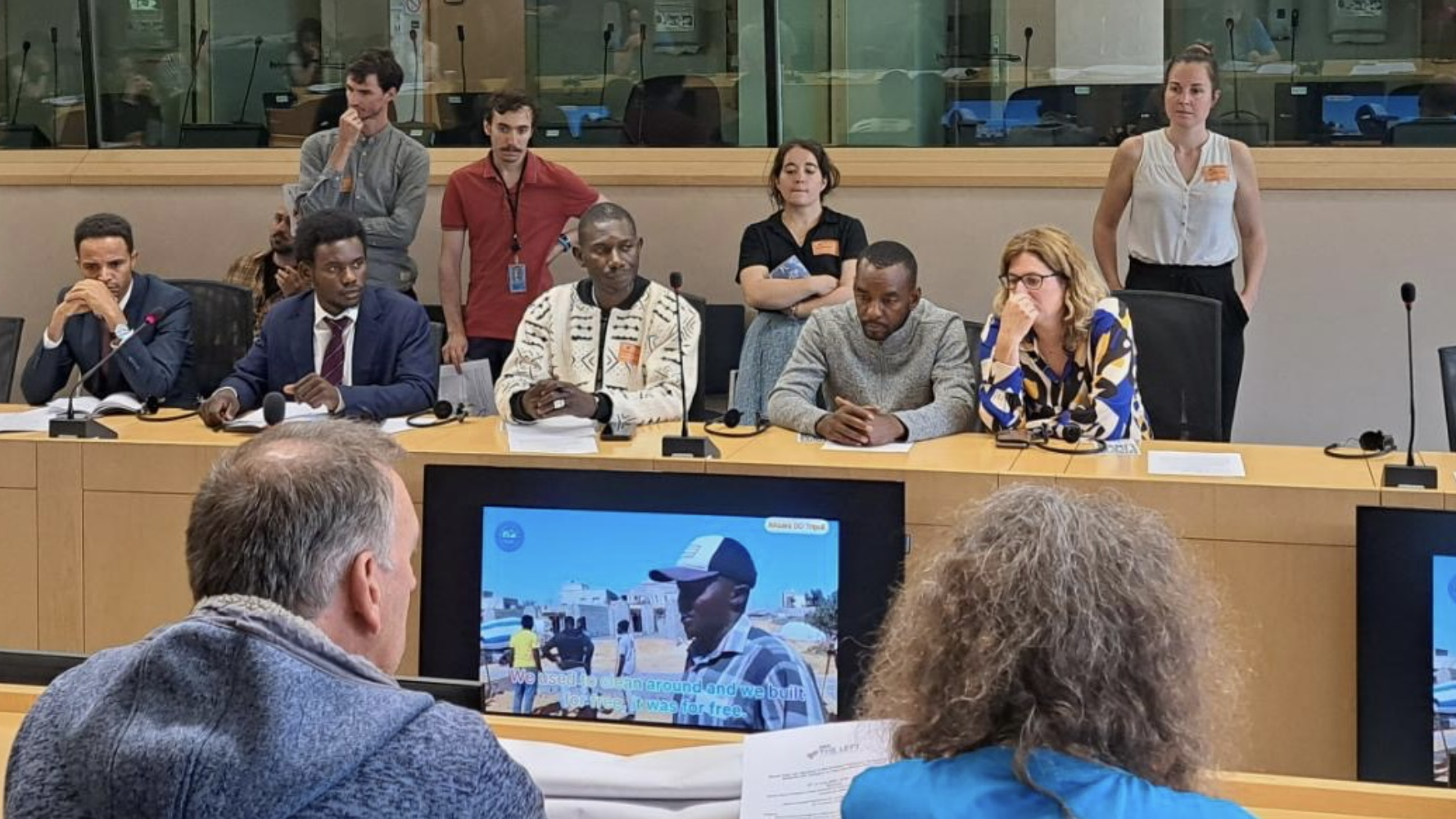
Remaining silent in the light of injustices is tantamount with being complicit.
UNHCR is chronically and severely underfunded.6 Approximately 85% of its funding comes from individual states and the European Union (EU).7 Each year, UNHCR only receives around 50% of the money actually needed to fulfil its mandate.8 The constant lack of financial resources contributes to UNHCR’s state dependency, especially with regards to big donors such as European member states. This vulnerability also leads to UNHCR staying increasingly silent in the light of deadly European migration policies and border crimes. However, we refuse to accept UNHCR's alleged ‘neutral silence’. Remaining silent in the light of injustices is tantamount with being complicit.
UNHCR provides a fig leaf to externalisation policies
The effects of these developments can also clearly be seen in UNHCR’s role in resettlement. With its activities in numerous countries, UNHCR upholds refugees’ hopes for resettlement to a safe third country. In fact, the chances for resettlement in reality are extremely low: less than 2% of all individuals qualifying for resettlement are actually resettled.12 This “abstract hope” that is merely more real than a dream, keeps people stuck in countries where they are not safe and cannot build a future, often for many years. With this “dream of resettlement”, UNHCR provides a fig leaf to externalisation policies of states in the Global North, keeping people far away from its territories and therefore finally assisting these countries in sealing off their borders.
Moreover, UNHCR often claims to be the “voice of refugees” or to speak on behalf of “all refugees”, which, not least, also reflects in their Twitter username “@Refugees”.13 Nevertheless, knowing that there is no system to hold UNHCR accountable for its actions, UNHCR in many instances has ignored the voices of refugees or their protest to bring attention to the violation of their rights has been silenced or invisibilised. No matter if in recent examples in Libya, Tunisia, Egypt or elsewhere in the past, self-organised and peaceful protests against UNHCR, in the vast majority of cases, have resulted in collective punishments, suspension of services, brutal evictions, and not rarely also in the detention of the demonstrators, enforced by UNHCR’s very own security personnel or national authorities.14
We would like to underline that, even in light of all these criticisms, we strongly believe in the importance of UNHCR’s mandate and work. Yet, looking at the future of refugee protection, we must ask ourselves: What will happen after UNHCR has lost all of its political leverage? Undoubtedly, it would be a decisive win for the International Organization for Migration (IOM), an organisation without any clear legal mandate to protect and speak up for those in need. This competition for funding and areas of operation between the two agencies, however, should not lead to UNHCR shying away and practically copying IOM’s role in migration management and border protection. Instead, UNHCR must hold up its mandate and stay true to its role of being an advocate and protector to displaced people and not a service provider in national border control policies.
Despite the standards and goals UNHCR claims to stand for, most of the general criticism brought forward against the agency also applies to its office in Libya. However, in the specific case of Libya that throughout the past years has become a major hub for so-called “irregular” migration to Europe, UNHCR has shown to particularly fulfil its unofficially assigned role as gatekeeper of the Global North.6
UNHCR Libya – Unable or unwilling to protect?
According to UNHCR official data, nearly 900,000 forcibly displaced people are in need of humanitarian assistance in Libya.15 Nonetheless, the estimated number of people in need of protection is believed to be significantly higher.
The situation in Libya, for more than a decade, has been dominated by political instability, daily violence, war, and continuous impunity.16 Besides, the interests of UNHCR donor states and the associated tightening of the EU border regime along the Central Mediterranean are contributing to the further destabilisation of the situation, reinforcing informal actors as well as criminal structures, and fueling an endless cycle of violence and repression against those who are trying to escape the Libyan hell.17
The reports of insufferable living conditions in which people are struggling to survive range from the constant risk of arbitrary arrests, forcefull pullbacks, kidnappings, to enslavement, sexualised violence, a lack of medical assistance, and a wide scope of other human rights violations. The Libyan Ministry of Interior describes these endeavours, in which many people in the past were either killed or wounded, as security campaigns against ‘undocumented migration’.1
Although UNHCR Libya is aware of and in the past even has condemned the brute force enacted by the so-called Libyan security forces against refugees 19, this still does not prevent the staff members from cooperating and making use of Libyan authorities themselves. As for example when UNHCR Libya, in January 2022, decided to close its Community Day Center (CDC) in Tripoli, leaving even those who had escaped or remained outside detention centres until then without assistance.20 Shortly after the announcement, many of the 1,500 people that gathered in front of the CDC to demand their voices for evacuation and better living conditions to be heard by the agency, were brutally evicted and detained.21
In fact, asylum seekers in Libya often end up in one of the numerous either state-run or unofficial detention camps within the country that, until today, remain places of violations and abuse, including beatings, rape, torture, and starvation.22 As a result, life-threatening attempts to escape 23, but also suicides of people inside the detention camps occur on a regular basis. 24 Not only has it been found that a significant number of detention centers are run or affiliated with armed militias, private gangs, and Islamist groups that highly profit from their cooperation with Libyan authorities.25 UNHCR reportedly also has lost control over a so-called Gathering & Departure Facility (GDF) it funds. Consequently, this official refugee housing facility became merely a detention centre run by Libyan authorities on UNHCR budget.26 In many instances, UNHCR was even denied access to the detention facilities. Especially in the South-East of Libya, the agency has no access to detention camps at all.27 In order not to lose the limited access it currently has, but also to preserve its own image and that of the agency, UNHCR staff members commonly refrain from reporting mistreatment and human rights violations.28 Although we acknowledge the restricted monitoring possibilities UNHCR finds within Libya, it is concealing the massive human rights violations committed inside detention camps in Libya, and must therefore be held accountable and considered complicit.
In registering asylum seekers, UNHCR even agreed to the Libyan government’s condition after which only nine nationalities may be registered 29 as persons of concern to UNHCR: Oromo Ethiopians, Eritreans, Iraqis, Somalis, Syrians, Palestinians, and Sudanese from Darfur.30 This systematically strips people seeking international protection of their right to asylum and has not only lead to unfair selection processes and structural discrimination based on nationalities, but also to forced deportations to the countries they had fled from.
Those that are being registered and receive an “asylum seeker certificate”, wait for extended periods of time before their refugee status determination is finalised – often up to ten years. During these lengthy periods of waiting and constant uncertainty, asylum seekers receive very little support or protection by the agency. Even after their refugee status determination is completed, most refugees are confronted with no possibility for resettlement to a safe country.31 In line with its core mandates, UNHCR’s task here is to hold states accountable for the lack of reception of refugees and to find alternative solutions, since staying in Libya is clearly not an option. In addition, the very limited capacities for resettlement are often not communicated to refugees. On the contrary, UNHCR staff in the past repeatedly made false promises about when and how asylum seekers will be resettled. Although UNHCR’s resettlement possibilities largely depend on the receptivity of donor states, the actual lack of resettlement options is neither made sufficiently visible through the agency’s publications, nor through their social media platforms.
While UNHCR’s resettlement programs in the past were either suspended or carried out very sporadically and without any transparency towards those that have been awaiting their evacuation for many years, UNHCR’s involvement in “voluntary” repatriation programs has expanded exponentially in recent times. 32 However, the Libyan situation raises many doubts about UNHCR’s and IOM’s ability to adequately screen for return risks, given the inhumane conditions refugees in Libya are faced with. The genuineness of the consent to repatriation seems at least equally doubtful, especially where – in the absence of alternatives – so-called assisted voluntary return becomes the only effective possibility to escape daily abuses and a situation of unprecedented violence. This perplexity is in line with UNHCR’s guidelines, according to which repatriation can be considered voluntary only when a person has the right to remain in the host country, is free from detention, and their rights are fully respected. 33
Furthermore, UNHCR Libya also shows a lack of efficiency and unprofessional handling of emergency situations, as when it comes to providing persons of concern with cash assistance that, as a matter of fact, may be suspended on short notice and without the arrangement of alternative solutions at any given time. 34 We recognize the limitations to the agency’s possibilities within Libya, but strongly believe that the existing options are not used to their full potential. Neither do we think that refugees should be the ones suffering under UNHCR’s inefficiency and failures to handle and address the prevailing circumstances.
At the same time, through UNHCR’s presence and European programs of so-called bilateral assistance, i.e. the boosting and rebuilding of Libyan institutions involved in “migration management”, the EU aims to pretend that the situation in Libya is under control and changing for the better. 35 However, in the light of unprecedented human rights violations, recurrent armed clashes between rival militias 36, and the persisting political crisis in Libya, this is far from the actual truth. UNHCR, in fact, has served Western countries as a mostly silent observer on the ground and welcome opportunity to shirk or even deny responsibility for the situation of refugees trapped inside the country. It is therefore also hardly surprising that the underfunding UNHCR is faced with globally, also prevails in Libya. As of 18 October 2022, UNHCR Libya has thus received only 44% of its financial requirements for 2022 (USD 70 million). 37
Even against the background of the highlighted criticisms and shortcomings, we still remain hopeful that UNHCR will comply with its legal mandate and will actually live up to its crucial role in refugee protection. After all, we are aware that we will, amongst others, also need UNHCR’s support, in Libya and globally, to fight racist border regimes.
To preserve its own image and that of the agency, UNHCR staff members commonly refrain from reporting mistreatment and human rights violations.
Footnotes
- UNHCR Global Tr report p. 23 Search for more ↑
- UNHCR Global Tr report p. 23 Search for more ↑
- UNHCR Global Trends 2024, p.14 ↑
- Bennis notiz google.de ↑
- UNHCR Global Tr report p. 23 Search for more ↑
- UNHCR Glo Something else ↑
Stories
Stories of Human Rights Defenders witnessing the negligence of UNHCR
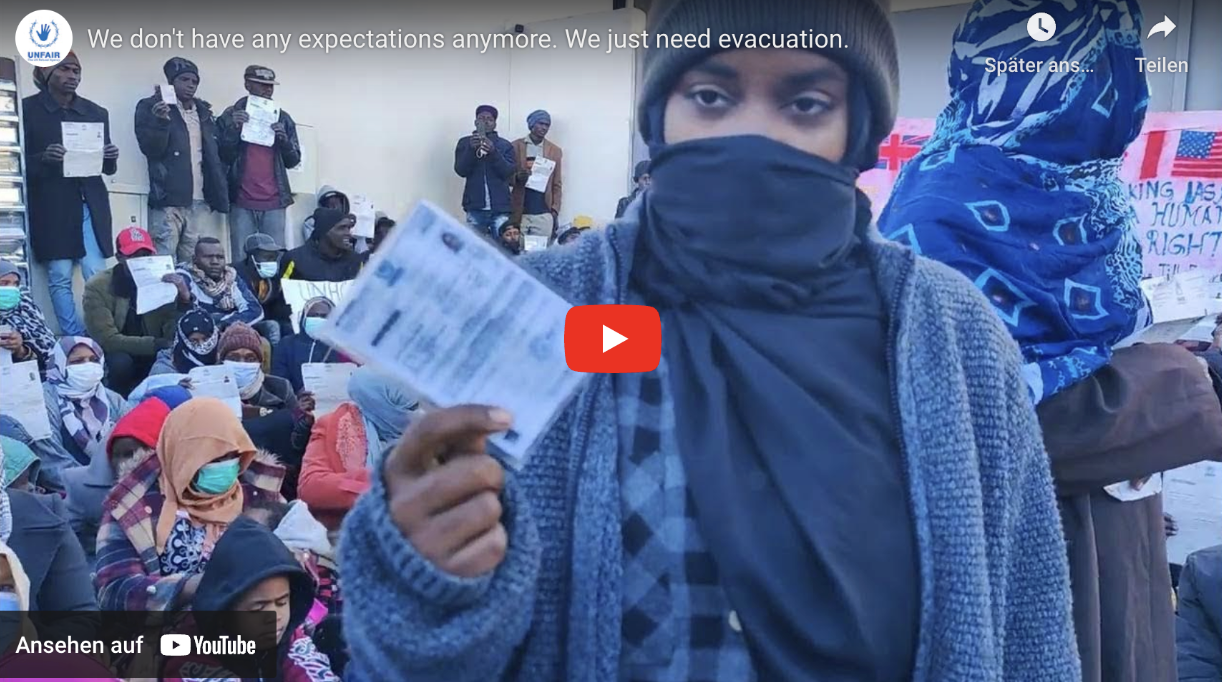
Naeima Yaqoub 8 December, 2021 Tripoli Libya - UNHCR headquarters
"We don't have any expectations anymore. We just need evacuation."
I’m shivering, don’t mind me, I’m sick. As you all know, I’ve been under the rain and water, etc. I’m just wondering if the human rights organizations, the UNHCR, or whoever is supposed to be speaking on our behalf—are they seeing us? Are they seeing these children? These aren’t even all of them; most are still laying sick in the community day center over there.
If they are accusing men of being violent for asking for our rights, since we can’t come here in the rain or in the middle of the night, then where is the kindness they say they’re giving us? Where are the services they’re supposed to be providing? We’re more than 300 ladies over there, and nobody has called us. Nobody has asked, “What are we? What are we doing? What are we eating? What are we even covering with at midnight?”
Forget about everything else. Have they seen the elderly, the children, the violence that they accuse us of causing? Have they ever experienced it themselves? Even if it means using violence against us, I need them to answer me. Why are they doing this? For what reason? Are we human? Are we supposed to have rights?
This document is supposed to give me rights all over the world, not just in this country. They’re supposed to give me rights all over the world, yet it seems to be just another piece of paper that might as well be thrown in the water.
David Yambio June 19, 2023 | English | French | Arabic
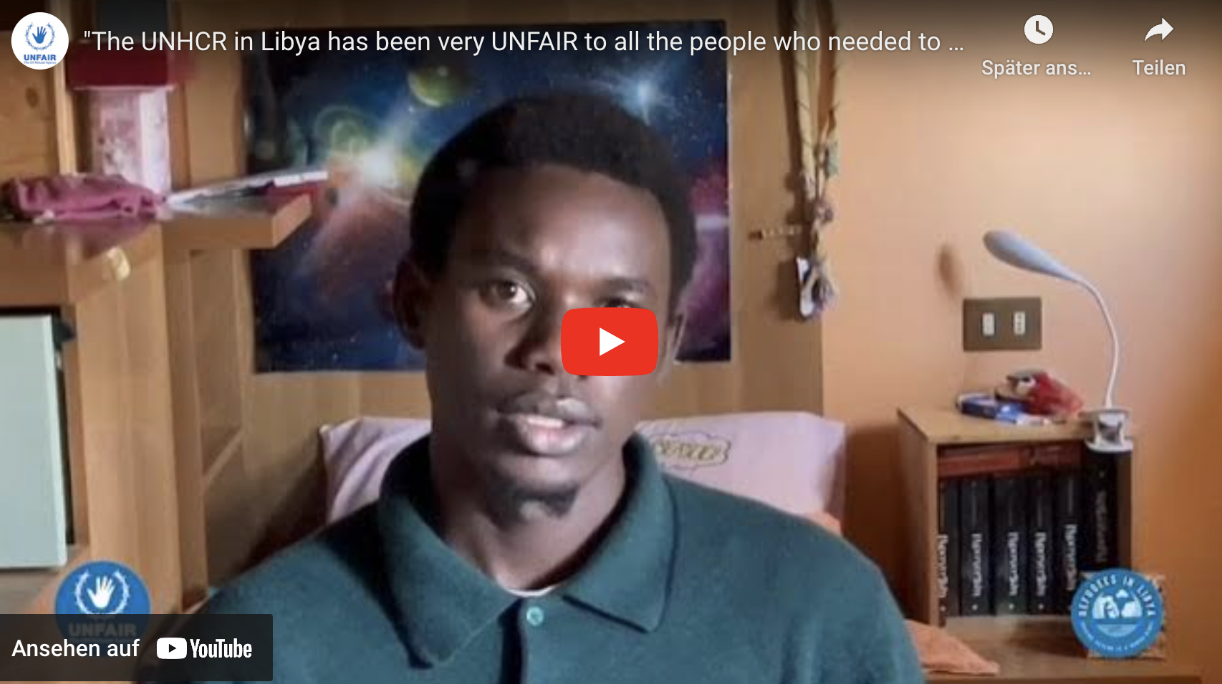
“The UNHCR is UNFAIR”
David Yambio from South Sudan is one of the spokespersons of “Refugees in Libya” and has recently managed to escape the Libyan hell. In this video he describes how he had initially fled from his war-torn home country to only experience “nightmares (...) made of torture, exploitations, and different circles of violence” in Libya. Even though David repeatedly called for protection and assistance to UNHCR Libya over a period of more than three years, he was met with nothing, but constant neglect, uncertainty, and brutal violence on the part of the UN agency. In response to the continuous violation of their rights and many unanswered calls, David, together with other refugees stranded inside the country, decided to form the collective “Refugees in Libya”. Their goal was to educate themselves about their rights, to protest against the unfair treatment that they had experienced for years, and to demand their voices for protection to be heard.
Anonymous June 19, 2023 | English | Arabic | French
“We expected UNHCR to negotiate for us. They did nothing"
A Sudanese refugee reports how he survived and escaped from the violent and murderous raids and mass arrests against refugees in the area of Gargaresh in October 2021. Shortly after, he, amongst thousands of other refugees, went in front of the UNHCR office in Tripoli to raise his voice and to demand evacuation to a safe place. After having spent three months and several days camping and protesting for their rights, the person in the video recounts how he and many of his comrades were brutally evicted and imprisoned in Ain Zara detention camp on 10 January 2022. While they expected that UNHCR would “come and negotiate and to find a solution”, nothing happened. Until today, they remain in the detention camp of Ain Zara and UNHCR keeps ignoring their calls.
Hassan Zakkaria June 19, 2023 | English | Arabic | French
“UNHCR usually doesn't reply on the phone”
Hassan is from Sudan and has arrived in Libya in 2019. After enduring months of constant war and conflict in the South of Tripoli, he managed to leave and apply for asylum at the office of UNHCR Libya. Despite the numerous challenges refugees in Libya are facing on a day-to-day basis, Hassan, until today, experienced hardly any support and a lack of protection from the side of the agency. Hassan also reports about how UNHCR in Libya is not responding to phone calls, usually denies people access to its office, and provides only very limited services to refugees in Libya. Even after Libyan authorities had used unlawful lethal force and conducted mass arrests against refugees in the area of Gargaresh in October 2021 and many people had nowhere to go, UNHCR Libya remained silent. In consequence to their calls for protection continuously being ignored by the agency, Hassan, David, and other refugees in Libya founded the movement “Refugees in Libya”, as it “is the only way we have to raise our voices and to tell what is going on”.
Anonymous June 19, 2023 | Arabic
"We are calling for emergent intervention to help us and save us."
I am a refugee like thousands of other refugees in Libya. Since I am here in Libya, I personally faced a lot of horrible incidents. I tried five times to cross the sea to Europe but with zero success, I had no chance to flee this unjust land of libya. We are afraid and threatened by the libyan militias and the international organizations. We just call for simple things, we call for fundamental rights such as housing, work, education, health system. Libya is a state of killers and traffickers. I have been registered with UNHCR since 2020, but I didn’t receive anything from them, no protection, no resettlement, nothing. I ran away from the prison because UNHCR didn’t protect me nor defend my rights, my simple rights. Unfortunately, it becomes our duty and task to raise our voices asking for help and evacuation to safe places. We are calling for emergent intervention to help us and save us from this hell. We demand all human rights organizations and groups to amplify our voices and our demands, maybe, they can do something that UNHCR refused, or failed, to do.
Anonymous June 19, 2023 | Arabic
"I want to offer better future for my kids."
A sudanese Asylum-seeker who arrived in Libya through Egypt. He was arrested at the Egyptian borders but then released in Tobruk. Tried to cross the sea a couple of times but failed. He decided to start his own business and opened a restaurant in Tripoli but the militias seized his restaurant and arrested him again. He managed to apply for protection at UNHCR. I have not been able to contact my kids and my wife since last October. I am broke financially and have no money, Also, mentally broke because of all that I face in Libya. All I hope is to offer a better future for my kids. To be able to provide them with the safety and life I didn’t have. I am dreaming to be one day at a safe place with no violations and no humiliations.
Anonymous June 19, 2023 | English
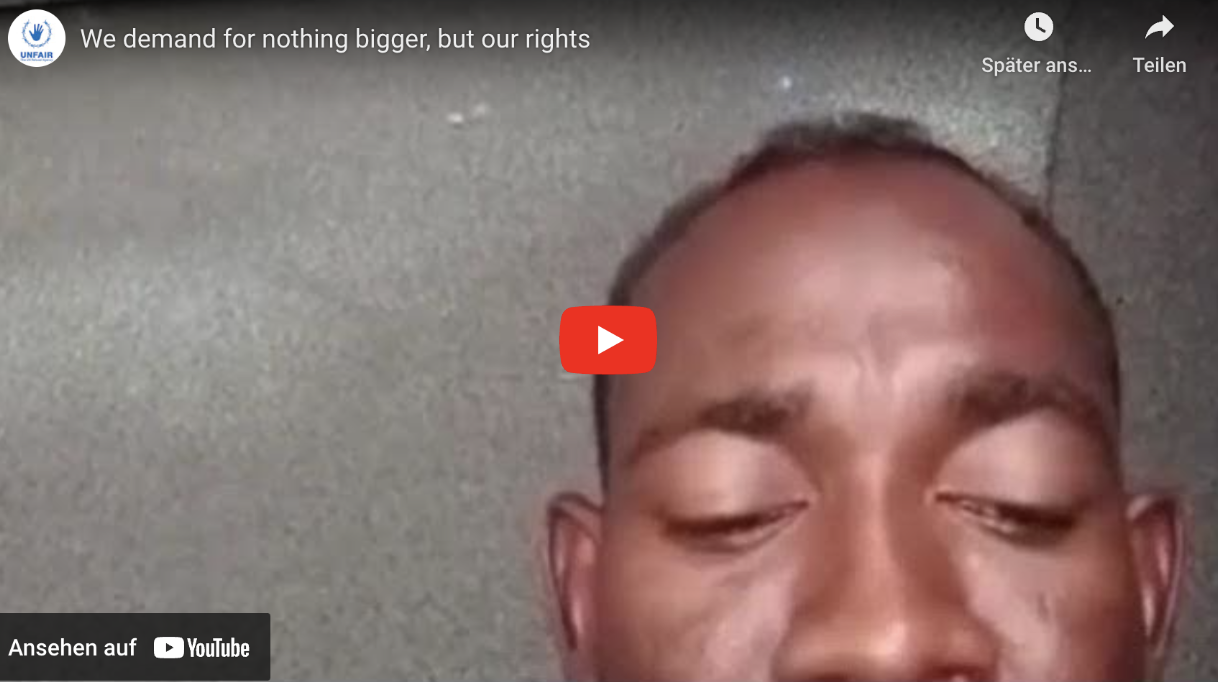
"We demand for nothing bigger, but our rights."
A refugee from Sudan describes how he had fled his war-torn home country in the hope to find safety in Libya. However, his expectations were soon proved wrong. Registering and claiming protection at UNHCR in Libya in 2021 until today has changed nothing about his dire situation. Even after trying to cross the Mediterranean to reach safety in Europe, being subjected to inhumane treatment and detention by the so-called Libyan Coast Guard various times, UNHCR remained silent. To finally make his voice heard, he and other refugees started to protest in front of the UNHCR office in Tripoli. On 10 January 2022, the protest was violently dispersed, and many protesters were detained. In light of all these disappointments, he again highlights that refugees in Libya only demand their basic human rights, as the right to safety and thus to be evacuated from Libya.
UNFAIR Brussels
Report of two days of protest in Brussels
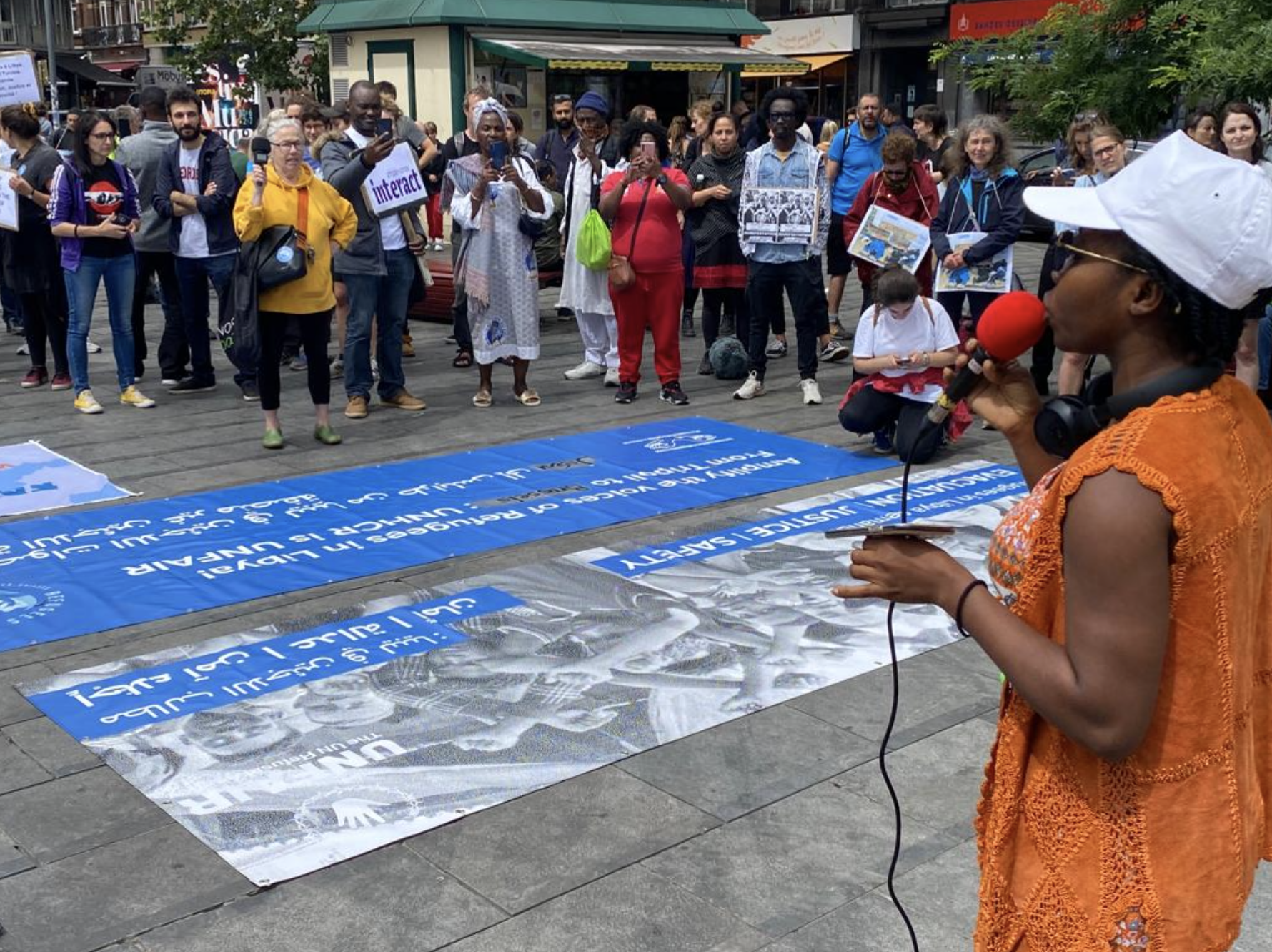
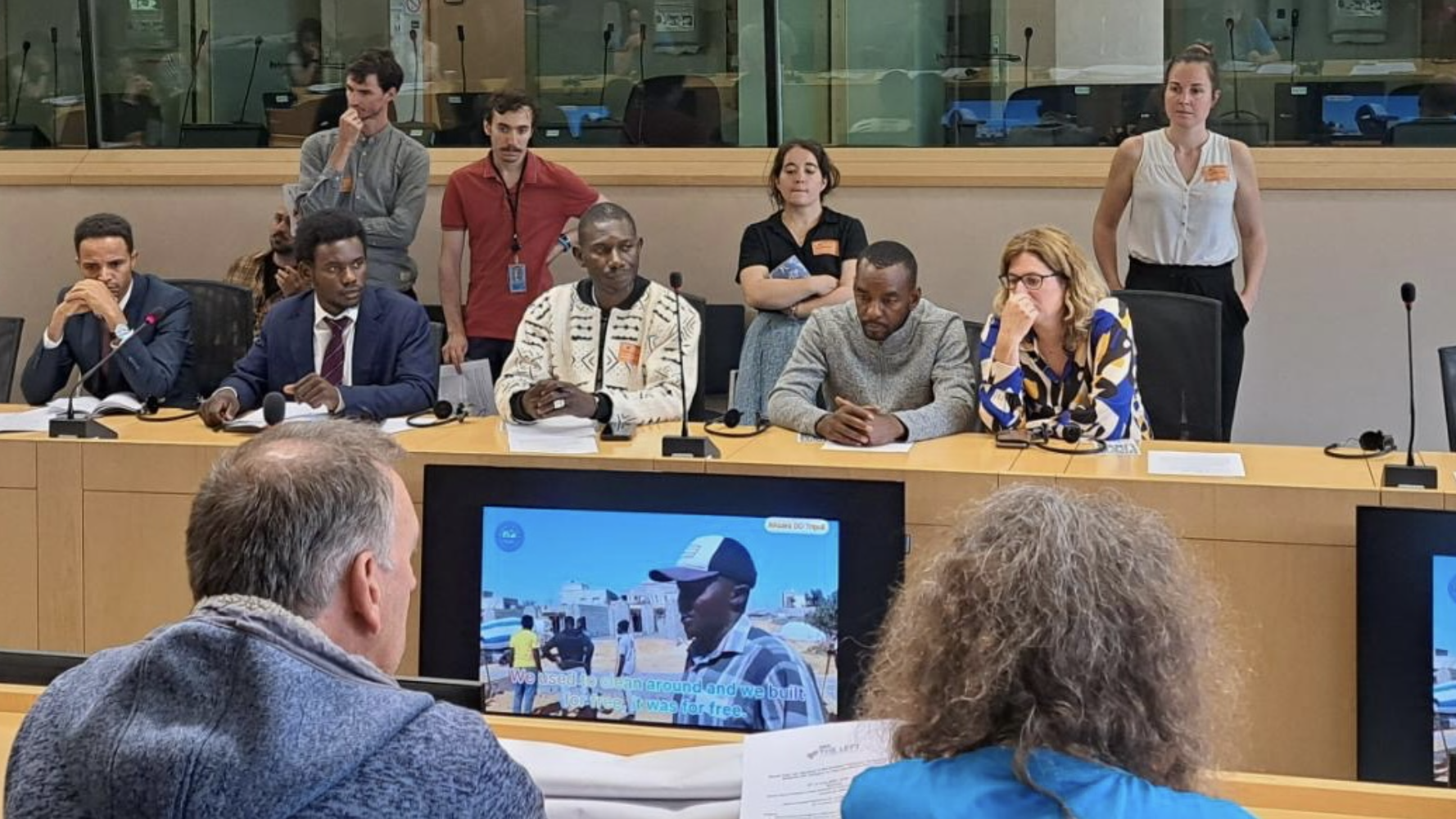
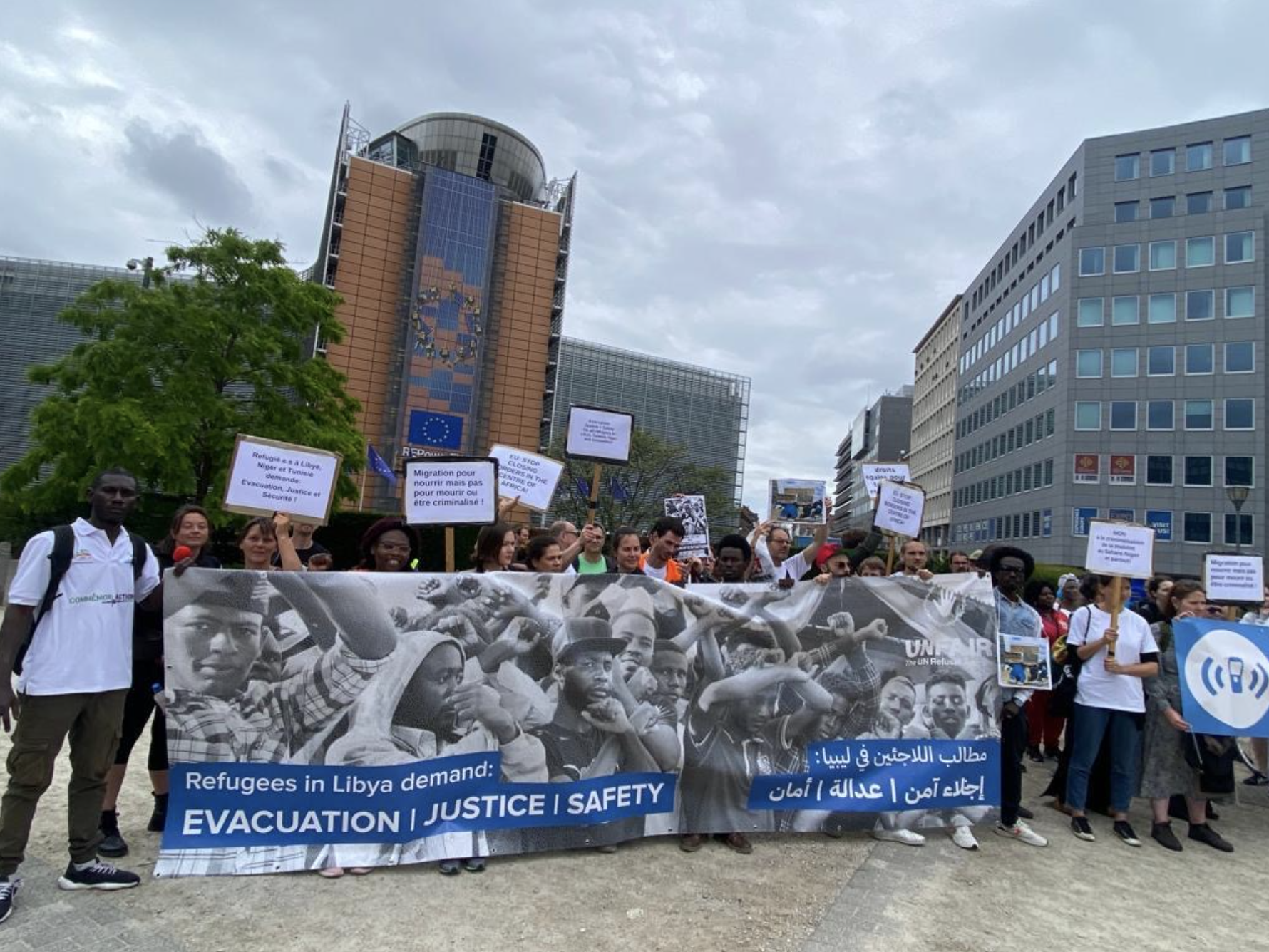
After the collective protests in December 2022 in front of the headquarters of the UNHCR in Geneva, Refugees in Libya and the support alliance mobilized for the end of June 2023 to the European capital. “From Tripoli to Brussels – amplifying the voices of Refugees in Libya” was the title of four days of meetings and camping, of lobbying and demonstrating. It started on the 28th of June with an exchange meeting with self-organised local actors from Brussels, mainly collectives of Sans Papiers, who are struggling for their right to stay and for housing. A women’s collective was also present, and they finally joined the demonstration a few days later with strong speeches and slogans. The 2nd day of 29th of June was characterized by a press conference inside the European Parliament and lobbying talks with parliamentarians. David Yambio (spokesperson of Refugees in Libya), Hela Kanakane (from Alarm Phone Tunis and on behalf of Refugees in Tunisia) and Moctar Nalosso (from Alarm Phone Sahara in Niger) were criticizing the European policy of externalization and the subsequent increase in violations of refugee rights in Libya, Tunisia, and Niger. David Yambio demanded again the release of his imprisoned comrades in Ain-Zara and of all refugees in all the detention centres in Libya. The press conference was followed by a meeting with MEPs belonging to the “The Left” fraction, in which the dehumanizing living conditions of people on the move were outlined with videos about the situation in Libya and in Niger. The 3rd day was dedicated to a “counter summit” in reference to the official EU council summit, which also discussed the migration pact, including the deportations to so-called third safe countries (like Tunisia).
The conference opened with a plenary, in which the history of the movement was shown, and the participants introduced themselves. Shortly after, the activists split into three simultaneous workshops on different topics: “Refugees in Libya: how to improve support for individuals”, “UNFAIR campaign – how to continue?” and “From North Africa to Niger: how to connect the struggles”. In the afternoon, the second workshop session focussed on the topics of “The role of externalisation” and “Legal work in Libya”. The day was concluded with the screening “Libya, No Escape From Hell” and a discussion with the director of the film, Sara Creta.
The last day, 1st of July, started with the closing assembly in which the content of each workshop was summarized and concluded with a rally, joined by local movements of migrants and Sans Papiers. The demonstration with about 150 participants crossed the capital of the European Union, passing the headquarters of its institutions and the offices of the executors of the brutalization of migration policies: the Council of the EU, the Commission, Parliament, UNHCR, IOM, Frontex, ICMPD.
THE RELEASE OF THE COMRADES, WHO WERE IMPRISONED IN AIN-ZARA
SINCE JANUARY 2021
On 30th of June, at the end of the counter-summit, the hoped-for news already arrived at the transnationally composed conference: Officials from UNHCR Libya had surprisingly visited the centre of Ain-Zara with an assessment on the detainees as a starting point for a release process. It was hard to believe, and at first it remained unclear, under which conditions the release should happen. But in the days after it became clear. Agreements have been signed, in which the conditions and methods of release were fixed: transfer to an urban area, financial assistance (in the form of cash and credit cards) for the accommodation and the purchase of non-food items, individual medical interventions based on specific needs.
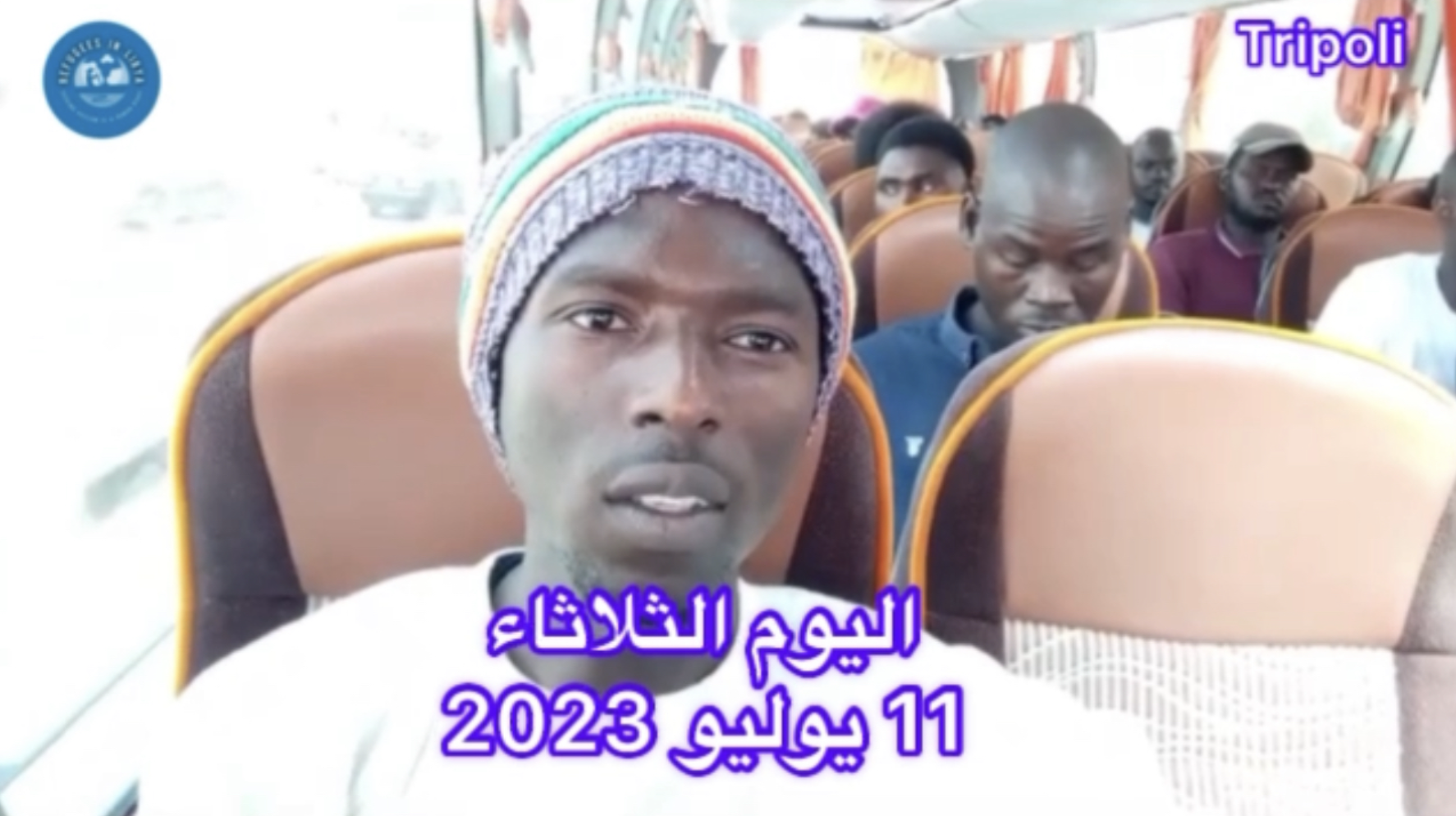
On 11 July 2023, after more than 500 days of living in dehumanizing conditions, 74 people found their freedom again. It was the first of two more groups, who were released in the following two days. The joy of seeing the comrades free was great, and obviously the courage of the representatives of Refugees in Libya and the supporting activities of the solidarity network and the UNFAIR-campaign had an impact. But concerns for the future of the released remain until they are evacuated. Today they are in a similar condition as they were a year and a half ago. Most of them come from Sudan, a country once again plagued by civil war. Libya is still a hell. More than 20,000 people are held in its official and unofficial detention centers.
The closure of all concentration camps and the evacuation to safe countries remains imperative. The fight will go on!
Unfair Geneva
Report of two days of protest in Geneva
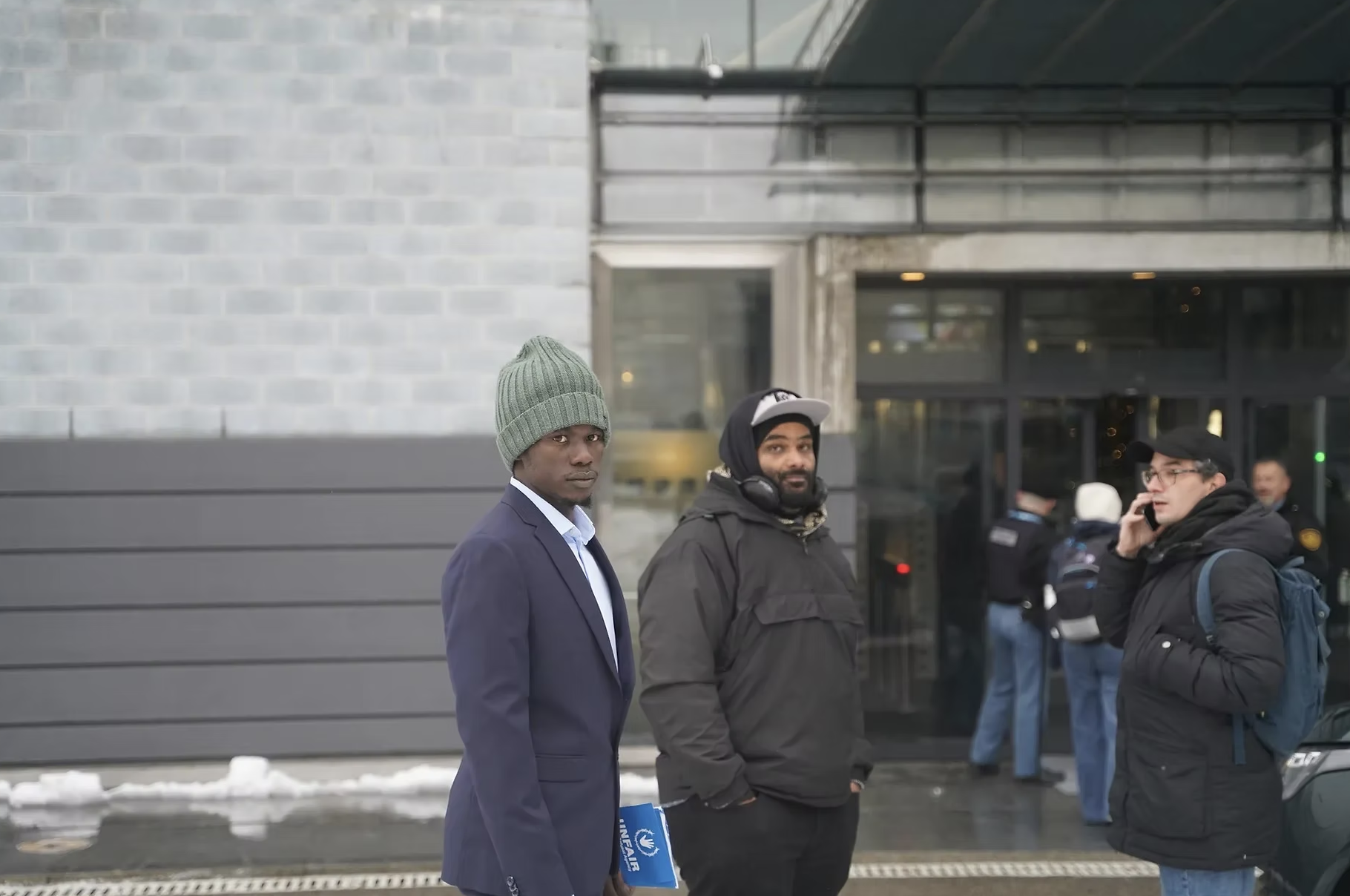
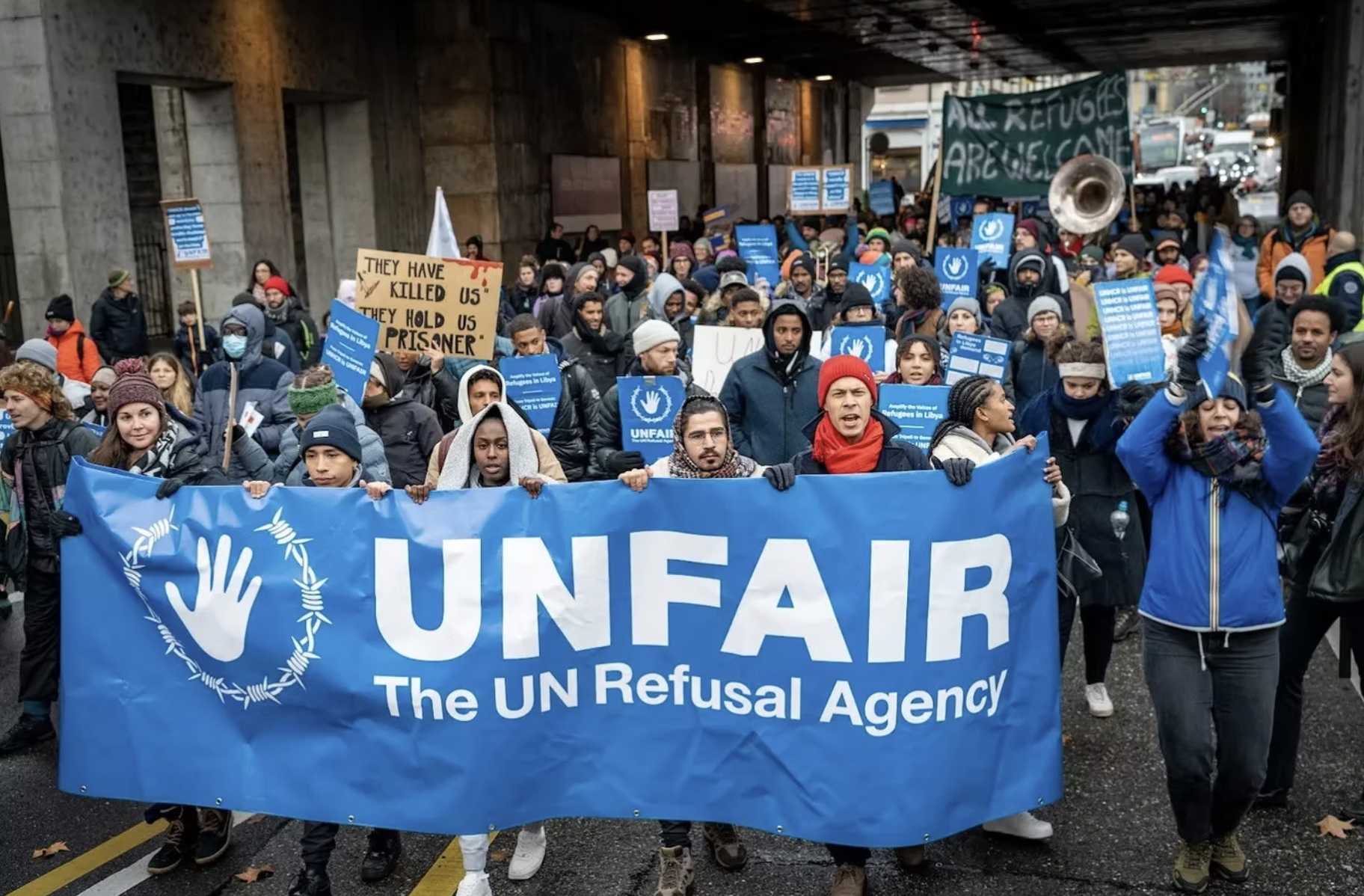
Full report
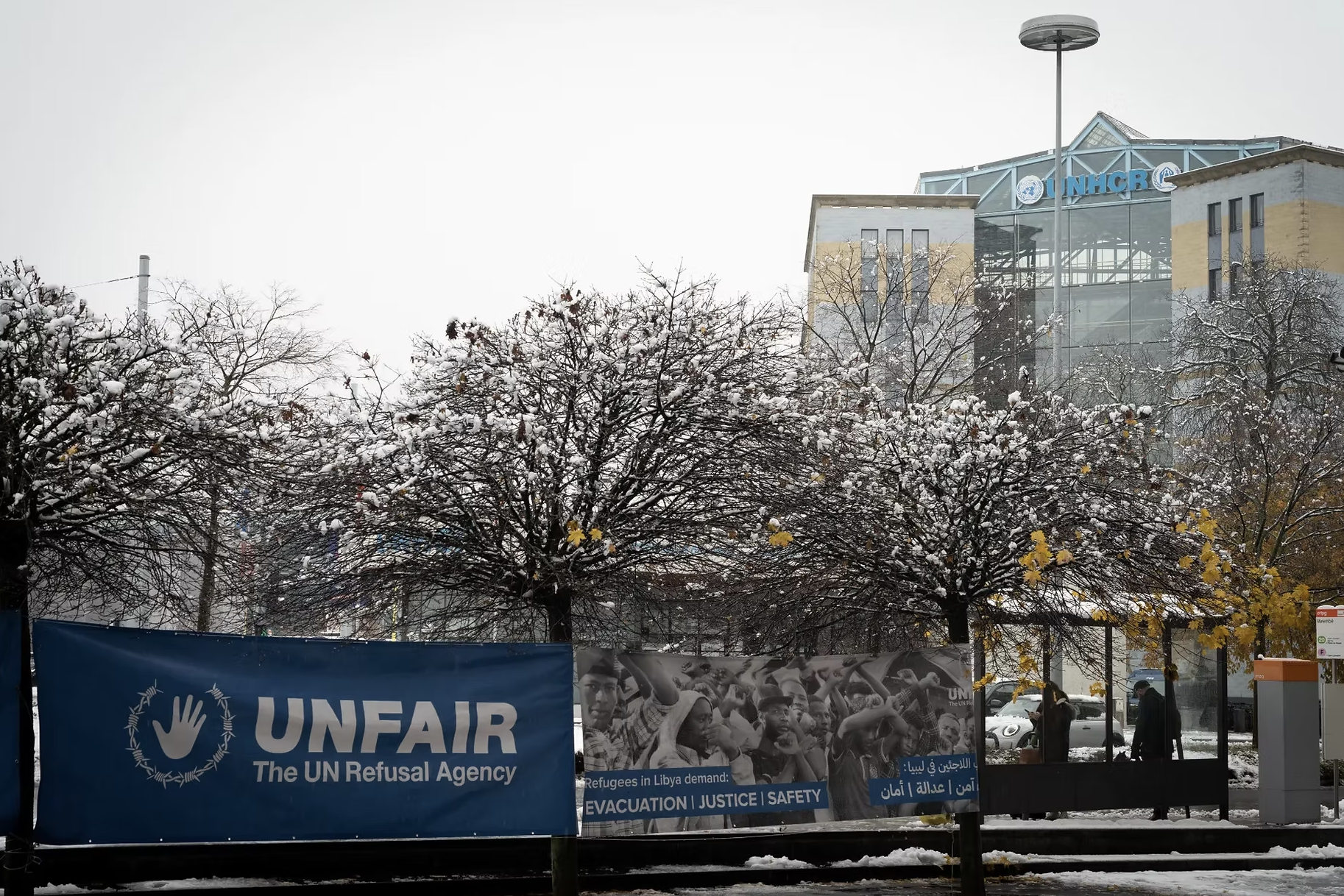
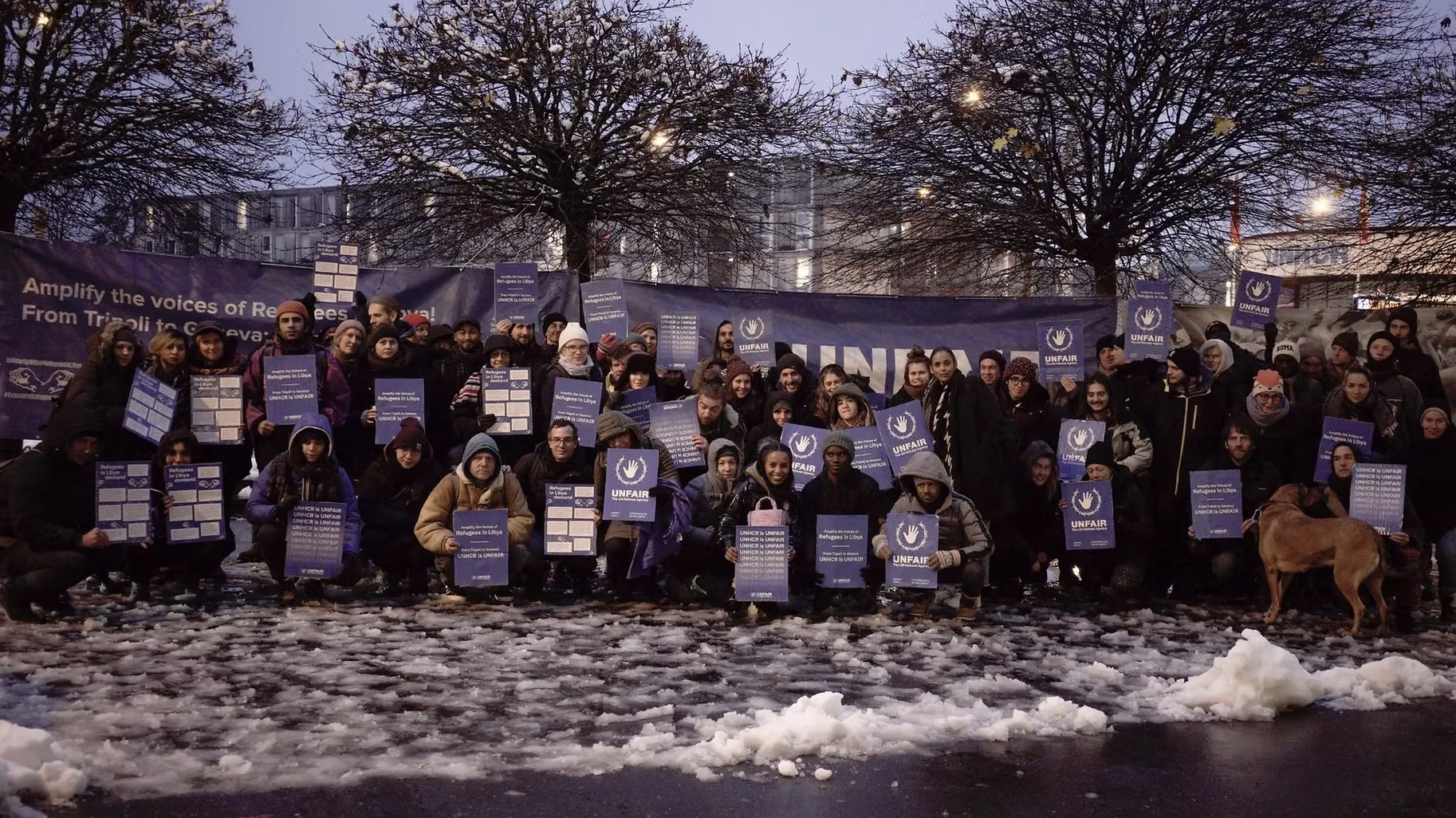
This weekend, on the 75th International Human Rights Day of the United Nations, a solidarity alliance formed by ‘Refugees in Libya’ and ‘Solidarity with Refugees in Libya’ met in Geneva, in front of the UNHCR headquarters to call for justice and fair treatment.
The group demonstrated looking at the building, in which officials of the so-called Refugees Agency take decisions about the lives of millions of vulnerable people around the world every day. While the first article of the UN Declaration of Human Rights says: "All human beings are born free and equal in dignity and rights", people in Libya had to stand up and protest for more than 100 days as the UNHCR systematically ignored their demands to be recognized as human beings and evacuated to safe countries.
This weekend, just over a year since the protests in Tripoli began, the few who made it to Europe mobilised to take the protest from Tripoli to Geneva. This time they were to be heard! The mobilisation started with a press conference in front of the UNHCR headquarters on the 9th of December denouncing all the injustices ignored and even committed by the UN Refugee Agency, followed by a sit-in with multiple contributions by affected people and concluded with a march through the city of Geneva the day after.
David Yambio was the first to speak: "I am here today representing the thousands of people still locked up in camps in Libya. We are talking about people regularly registered as refugees with UNHCR who have been prevented from fair access to the asylum process”.
His account was followed by the fellow campaigner Lam Magok, who was trapped in Libya for five years: "We are human beings like everyone else. We are like Ukrainians. There are no A and B migrants''.
Azeb Ambessa of the ‘Solidarity with Refugees in Libya’ and ‘United4Eritrea’ networks explained that "The transnational movement was born shortly after the start of the protest in Tripoli to amplify the voices and demands of Refugees in Libya”, and adds that “The European Union’s border regime is complicit as financier in torture, killings and rapes that take place every day in the detention centers in Libya”.
The press conference was closed with a contribution of lawyer and activist Muhammad al-Kashef of the ‘Solidarity with Refugees in Libya’ network as well as co-founder of Refugees' Solidarity Movement in Alexandria, Egypt. He scandalised how more than 70 years after the signing of the Geneva Convention, the UNHCR had failed its mission "not only in Libya, but also in Sudan, Egypt, Tunisia, Algeria, Morocco, Turkey and even in the Greek islands'”.
Following the press conference, a small delegation of the alliance was invited to speak to Alex Tayler, the Senior Liaison Officer for the Middle East and North Africa at the UN. In the conversation David Yambio and Muhammad Al-Kashef were stressing the demands of the campaign – to be found here.
We brought these demands to the streets in Geneva, while many of our comrades in Libya and people on the move risk their lives to claim their basic human rights. We are struggling together and we will continue until our demands are heard and put into practice by the UNHCR.
In spite of low temperatures and wet feet the sit-in was continued until legally obliged to leave the premises. The evening was sparked with interventions from the Sudanese, Eritrean and Afghan communities stressing their horrendous living conditions and neglect of rights through EUropean authorities. The evening closed with the screening of videos shot during the 100-day struggle in Tripoli and the short film "ABBAS" by Sudanese filmmaker and activist Mustafa Zeyo.
The protest continued with a strong march on the following day, 10th of December and the United Nations ‘75th International Human Rights Day’ from ‘Place des Nations’. The crowd crossed the city shouting “We are here and we will fight – Seeking asylum is everybody’s right!” and "UN Agencies – Stop ghosting refugees” until arriving at Place de la Navigation, in the middle of the Paquis neighbourhood where 80% of houses are inhabited by ‘foreigners’. Here the demonstration ended with several artistic and musical performances and a promise to this only being the start for something bigger to come.
Watch a documentary here
Our struggle, in fact, does not end here. We will continue to expose the violations of the UNHCR, the European Union and its Member States. We will continue to expose racist and criminal border regimes that have caused
thousands of deaths at Europe's internal and external borders. To fight the birth-lottery privilege and to stand together for the Freedom of Movement for everyone.
Find the recorded live-stream of the event in our Youtube-Channel.
Media Coverage
Federica Marsi, Aljazeera [EN] »Asylum seekers take to the UN to reclaim inalienable human rights«
Reading time: 9:00min
Charles Heller, Border Forensics [EN] »The human despite all«
Reading time: 37:00min
Mada Masr [EN] Instagram-reel
Tribune de Genève [FR]
https://www.tdg.ch/pres-de-300-personnes-defilent-pour-soutenir-les-refugies-
en-libye-730232192013
Pietro Barabino, Il Fatto Quotidiano [IT]
https://www.ilfattoquotidiano.it/2022/12/11/ginevra-la-protesta-dei-rifugiati-unhc
r-disinteressata-ai-profughi-migranti-subito-via-dai-campi-di-detenzione-in-libia
-verso-paesi-sicuri/6901742/amp/
Melting Pot [IT]
https://www.meltingpot.org/2022/12/evacuazione-in-paesi-sicuri-e-protezione-i
-rifugiati-portano-le-loro-richieste-a-ginevra/
Pitt von Bebenburg, Frankfurter Rundschau [DE]
https://www.fr.de/politik/david-yambio-und-der-weite-weg-nach-genf-91965005
.html
Christian Jakob, TAZ [DE]
https://taz.de/Fluechtlinge-protestieren-gegen-UNHCR/!5902274/
Interview von Lukas Tobler mit David Yambio, Die Wochenzeitung [DE]
https://www.woz.ch/2249/aktionstage-in-genf/das-unhcr-gibt-sich-besorgt-alles
-luegen/!CPQSV41SVH4T
Sarah Heinzmann, Rabe-Info [DE]
https://rabe.ch/2022/12/09/von-tripolis-nach-genf/
Further Readings
Jeff Crisp
Jeff Crisp (2022). “Protected? UNHCR’s organisational culture and its implications for refugee advocates and activists”
The author gives an inside perspective into UNHCR’s structures and how activists and advocates can best approach the agency with their concerns. Activists and advocates, according to Crisp, have the important tasks of holding UNHCR accountable to provide proper protection for refugees and ensure that it expands its agency. He explains that refugee protests put UNHCR in a difficult situation, which is why it responds with repression.
Available at: https://carleton.ca/lerrn/2022/unhcr-organizational-culture/
Stephan Scheel and Philipp Ratfisch
Stephan Scheel and Philipp Ratfisch (2014). “Refugee Protection Meets Migration Management: UNHCR as a Global Police of Populations”
The article shows the entanglement of UNHCR’s humanitarian practices in border control measures and policies. By UNHCR making selections on behalf of states, many people who seek protection are turned away and even criminalised. When they protest, UNHCR turns away to maintain its own moral authority.
Available at: https://www.tandfonline.com/doi/abs/10.1080/1369183X.2013.855074
Amera Markous
Amera Markous (2019). “Humanitarian Action and Anti-migration Paradox: A case study of UNHCR and IOM in Libya”
Amera Markous conducted research in Libya with refugees and staff members of UNHCR and IOM. She could prove that the agencies are not only putting donors’ interests above those they are supposed to protect, but that these practices also actively harm refugees and asylum seekers. Although she acknowledges the constrained conditions under which UNHCR Libya operates, she also highlights the lack of professionality and insufficient communication on the site of the UN agency.
Available at: https://drive.google.com/file/d/17N2EIPlWyt-mLO6zyri74FLOuRRRy0U5/view
Barbara Harrell-Bond
Barbara Harrell-Bond (2008). “Protests Against the UNHCR to Achieve Rights: Some Reflections”
Harrell-Bond, one of the most influential researchers in refugee studies, explains that there has always been protest by refugees against UNHCR. However, in the vast majority of cases, it has been silenced and invisibilized. A grave problem is that refugees who experience rights violations from UNHCR officers have no chance to take legal action against staff members. Complaining at the UNHCR headquarters may even result in threats of withdrawing their refugee status. There is also no system or mechanism in place to hold UNHCR accountable. This is why many refugees instead decide to organise and protest, which also may result in punishments by UNHCR or violence by police and military on behalf of the agency.
Available at: https://link.springer.com/chapter/10.1057/9780230583009_11
Carolina Moulin and Peter Nyers
Carolina Moulin and Peter Nyers (2007). “‘We Live in a Country of UNHCR’ – Refugee Protests and Global Political Society”
In their article, the authors analyse the events of the refugee protests in Cairo, Egypt in 2005 and the strategies that were used by the protesters to achieve their rights for recognition and self-determination towards UNHCR. They argue that, within a global political society which is shaped by constant ambiguities and ever-shifting power relations, there exists no space that foresees “opportunities for refugees to actively reformulate the governmentalities of care and protection”. At the same time, Moulin and Peters emphasize how the protesters in Cairo countered these developments through re-taking their political voice and defining their own norms of care, protection, and security.
Available at: https://academic.oup.com/ips/article-abstract/1/4/356/1824253
In solidarity with all people on the move and in order to stop the suffering in Libya, the deaths at the borders and at sea, we demand from UNHCR and its regional office in Libya:
to take on responsibility for all people on the move detained in Ain Zara as well as within all other detention camps in Libya and to ensure their immediate release
to promote community-based alternatives to detention and to provide humane and dignified reception and living conditions for refugees in Libya and elsewhere until resettlement is possible
to guarantee all people on the move in Libya and elsewhere have access to a fair and transparent refugee status determination process, as it is the legal procedure that represents the first step towards the granting of international protection
to ensure justice and equal access to rights among all refugees in Libya, independent of criteria of vulnerability, nationality, age, sexuality, or gender
to repeatedly call on safe countries to increase resettlement quotas and to accelerate and ease evacuation procedures
to engage in exchange and sincere dialogue with "Refugees in Libya" and other grassroot networks on the ground and to recognize them as equal negotiation partners
to facilitate access to humanitarian and legal aid services in Libya and elsewhere and to refrain from the suspension of its services at all times
to create transparency and to openly communicate their own limitations rather than upholding false expectations
to cease any collaboration with criminal structures and to put clear and rights-based conditions on cooperations with Libyan government actors
to call on the Libyan government to sign and ratify the 1951 Geneva Refugee Convention and its 1967 Protocol in order to create a legal basis for refugee protection within the country.
to clearly and openly condemn the European externalisation politics and to resist being abused for the EU’s isolationist policies
to advocate for the end of violent pullbacks, pushbacks, and all other organised practices of border violence