The collective hotline
+49 176 58 446 89

Libya has become a trap for hundreds of thousands refugees and asylum seekers. Without any protection (even the UNHCR document is not recognised by local authorities) they became prey to systemic exploitation by militias, by armed local groups and by simple Libyan citizens who know that the “illegal” immigrants cannot complain about them. The situation has dramatically deteriorated in the first weeks of 2025 due to a brutal wave of hatred coming from both the Libyan civil society and the government which fuels expulsions of so-called “illegal” migrants. We share some of the voices that reached the Hotline. Over 4000 messages reached the hotline so far.

Insight of Messages between 16.04.2024 - 15.11.2025

1 / 16

Woman, 15.11.2025

Since 2003, we have suffered from displacement multiple times, fleeing from Hajir to the Mournei camp. Before April 15, we were besieged in Mournei camp for three months. On June 26, 2023, Mournei camp was raided, our home was completely destroyed, and we lost everything. We then moved to Rongatas camp, where I was beaten while seven months pregnant. This caused complications that severely affected my health. With no doctors or functioning hospitals, I was transferred to Saraf Omra. Tests revealed anemia and placenta previa, leading to a cesarean section after months of suffering. After the delivery, we fled Sudan to Libya.

We entered Libya on February 27, 2024, through the Gatroun border. On March 2, 2024, we were detained between Sabha and Tripoli. Our passports and marriage certificate were confiscated. We were released only after paying a bribe, but we couldn’t afford to recover our documents. To this day, we receive threatening calls from unknown numbers demanding exorbitant fees for their return, which we cannot pay.

On September 22, 2024, my husband was attacked by unknown individuals who beat him on the head, eyes, and hands. We contacted the (emergency) hotline and reached out to organizations like CESVI. They told us it was a security issue beyond their capacity to resolve. We know we are registered with the UNHCR, but we have no other refuge.

As a nurse, I have faced significant challenges due to bullying and racism from colleagues, including harassment when I arrived late because of unreliable transportation. I worked at more than seven clinics but was often not paid. This happened repeatedly.

Due to my baby crying, I have been subjected to insults and threats to leave our rented house. Sometimes, people knock on the door while my husband is away for work, which terrifies me.
I contacted the (emergency) hotline several times, but they continued to tell me it’s a security issue.
I was once raided in our rented house while my husband was in Ajdabiya. We were three families sharing the home, but the others left because of financial constraints. I couldn’t leave due to my own financial struggles. At times, the electricity is cut off for days, and the house was sold. The landlord is now demanding we leave the property

Anonymised, 18.09.2025

Happy New Year, and may God grant you and yours a safe, secure and stable life.
While our lives are unstable, there is no security and safety, always fraught with danger... until when?

Anonymised, 27.01.2025

Peace be upon you, I know that you are not affiliated with UNHCR, but the information that was sent to you is to help others, meaning refugees and other migrants, because people are very tired in Libya, I am a widow with four children and my life is always at risk, that's why I tell you that I have no problem downloading my name to you despite the UNHCR file, but I know that you can only comfort me and thank you for your concern for all refugees and migrants in Libya, I wish you all the best.

Anonymised, 11.01.2025

The world’s silence in the face of what is happening in Libya and Sudan is a tragedy. We are facing a humanitarian crisis that requires urgent global action from UNHCR.

Our lives in Libya are an ongoing nightmare. We are living an unprecedented humanitarian tragedy!!! Where is the justice????? The silence of UNHCR and the world in the face of what is happening in Libya and Sudan is a tragedy. We are facing a humanitarian crisis that requires urgent global action from UNHCR

Anonymised, 29.12.2024

I want to live a decent and happy life, learn, achieve my dreams, and build my future like other people. The story is still not over, but it is long and all of it is written on a mobile phone in the form of a message So I'll sum it up here I ask for a special return if I have the rights of humanity and my rights as a human being, a refugee, for the rest of my life to live a life free of problems, wars, and targeting, and you are like your role or your duty, a humanitarian organization or an organization.United Nations for Refugees. My only hope is that you will protect me from these people and guarantee me a safe life like any refugee person and evacuate me as soon as possible. If not, I don't deserve all this I am honored to have had the opportunity to tell you my concerns, even though for a long time I do not know how to complain about my concerns and pain to anyone other than God.

Anonymised, 29.12.2024

The first problems or (wars) What happened in Sudan in 2003: militias attacked us in the village of Taabna, burned our house, and killed my brothers, older than me, and my mother. I lost the most precious person in my life in that war. They killed my mother in front of my eyes. May God forgive her and have mercy on her I was 4 years old and have been an orphan from that time until this day We were living in North Darfur state, the Adar region, in a village called Abonti. I was born in Karnoy, a village where I grew up, which belongs to the Kabkabiya locality, located exactly west of North Kabkabiya. But now the name of the Adar region has been changed to Kawthar after the Janjaweed or militias took over the village of Tabena. They displaced us and lived in our homes. We were living a simple life, thank God. We ate from our own food and thanked God for His blessings. But suddenly, light disappeared, and life turned into darkness—the opposite of the life we were all living. Suddenly, the Janjaweed attacked us and burned our homes or our yard. They killed our mothers and brothers, and I lost hope in life. The moment I was separated from my mother was the hardest feeling in life, especially at a time when I needed her more than ever before. We were displaced from our country and left behind everything we had, including money, land, agriculture, sheep, and other things, all that we had in life and we escaped with our lives caught between death and life, through circumstances, suffering, and hardship of living in a street or on my way, which only God knows, all of which are not written in a letter.

All of it can’t be written in a letter. I still remember the moment we were displaced from our village and our homes—my father carried me on his shoulders for two days until we reached a locality called Karnoi, which also belongs to North Darfur State. We stayed there for two months, and those months felt like two years—full of suffering, hunger, and humiliation. Finally, by the grace of God and with the help of the United Nations Refugee Agency, we were received and given food and water. From there, we were transported in large vehicles to a place called Tina in Sudan, a border area between Chad and Sudan. We stayed there for one month and twenty days. After that, an organization divided us into groups and placed us in refugee camps in eastern Chad, Milli camp.
Date of entry into Chad 1/3/2004.

From that day until now, I’ve become a refugee and an orphan at the same time. I haven’t been able to return to my country, Sudan, and I still can’t go back because there is still no safety there, and the war is still ongoing. My country has been taken over by the Janjaweed and militias—they displaced us and took over our homes. I’ve suffered so much in life, more than enough. If I were to tell all the suffering I’ve gone through during this war and the life I’ve lived in the refugee camps in eastern Chad—and the way the Chadian people treat refugees—it would be even harder. Even the organizations present in the camp, I’ve gone to many of them and told them my story, but unfortunately, there has been no response. We are still suffering a lot, and all of this can’t be captured in a single letter. So I’ll stop here for now.

The second thing we suffer from is the economic hardship and life in the refugee camps in eastern Chad—specifically in the Milé camp. At the beginning, things were going okay, thank God. The UNHCR provided us with food supplies that we used to eat and drink from. But over time, the economic situation worsened, and the organization could no longer provide for all our needs as refugees. And the Chadian people show no mercy. So, I had to rely on myself just to avoid dying from hunger. We turned to manual farming during the rainy season, even though I didn’t own any land to farm because I’m a refugee in someone else’s country. We farm on a shared basis—meaning the landowner gives you, for example, 100 kilos worth of land to farm, and in the end, you split the harvest: you take 50 and he takes 50. The distance between the camp where we live, and the farmland is extremely far—we walk on foot for half a day. In short, if you don’t have your own land and you're living in someone else’s country, life becomes harder than you can imagine. A major tragedy happened to me because of this—I lost my father, even until now. One day, my father and I went out to farm so we could plant and return to the camp the next day. Before we even reached the farmland, we came across a dead body near the farming area. God knows who killed him or why. This happened on 10/5/2015 in a place called Goz Beida, which is Chadian territory near the Sudanese border. The closest border areas are Kulbus and El Geneina. We informed the landowner about what had happened—just out of humanity and a sense of responsibility. But that day, I learned what so-called 'humanitarian action' really means. The landowner contacted some people—I don't know if they were police, bandits, or civilians, but they were all armed. They forced my father into a car and took him away. I don’t know where they went. I was 15 years old. They told me, ‘Go tell your family that your father is accused of murder,’ even though he was the only support I had after losing my mother. They said, ‘Your father is a suspect, and we took him with us.’ It was one of the most painful moments—seeing your mother burned alive in front of your eyes, and then your father taken away in front of you. No one can understand that pain unless they’ve lived through it. I didn’t know what to do in that moment. I collapsed and fainted. I didn’t even know where I was. After several hours, some people found me, took me to a hospital, and I eventually regained consciousness. At that moment, I had no idea who to talk to. From that day on, we never heard anything about my father. We don’t know if he’s alive or dead. The last time we heard anything was on October 1, 2019—someone said he was in Kulbus Prison, which is in a border area between El Geneina (West Darfur) and Chad. Since then, we haven’t heard his voice or received any news about him. Losing both of your parents when you're at an age where you need them the most is one of the hardest things. And what’s worse is that they were innocent—pure and blameless like a child. They did nothing wrong.

Why is all this happening to me? What did I do to deserve this? Where are human rights? Where is the right to simply live? Honess? I went and complained to the organization in the camp about what happened, but sadly, I never got any response. That’s when I realized that I have no voice, no human rights—as if I’m not even considered a human being, just a refugee in a camp. What can we do? God is greater. I accepted this reality. These are the trials and tests from our Lord, and I’ve come to terms with what happened to me. Alhamdulillah (praise be to God) in all circumstances.

Anonymised, 03.11.2024

Honestly, the situation is tragic right now. The police and internal security forces at the checkpoints are harassing people. In the mornings, they stop you, check your documents, and make you get into their vehicles to search your belongings. They’ll take whatever you have, saying, ‘You're Sudanese,’ and after taking what’s in your pocket, they say, ‘We’re letting you go—take care of yourself.’

Even the children throw stones at refugee homes. And young men over the age of 18, when driving by, will harass you or even hit you for no reason. It feels like everyone is like this.
I even contacted the UN agency’s partner, the only organization that offers legal protection, about what's happening, but I haven't received any response so far.

Even today, I called the hotline at 1404, and they told me that the UN doesn’t have any service related to legal protection for issues like police harassment, threats, and bullying by security forces. They said, "You came here illegally." I replied that, yes, I did cross the desert, but I didn’t come here to stay—I came to cross the sea. [...]
The employee didn’t even know how to communicate. I tried to explain politely, saying, ‘Sir, please be patient with me. I have a speech impediment, I stammer, and my hearing is weak’ But he responded rudely, saying, ‘Forget the stammering and the weak hearing,” then cut off the call.

How can we understand this? When you try to speak honestly about what’s happening, they get angry. Even during the call, the employee was annoyed. I really don’t understand—are these crimes they’re committing truly supported by the international community? It’s as if they have full support, or how else could it be like this?

Anonymised, 20.10.2024

Reason for contact: ‘Add a new complaint’ On the evening of Wednesday 2024-10-16 I was subjected to a semi-kidnapping incident by two young Libyans when I requested a taxi to return to my residence and they demanded a ransom of 50 D.L. or take me to a police station or a military gate. I only had 30 D.L. which was my wage at the work from which I returned, they took it from me and dropped me off in the middle of the road as night approached, they heard obscene words and I had to complete the journey on foot.

I would like to add this incident to my record of unfortunate events and request an appointment with a psychologist to receive the necessary support to overcome the nightmares that have been accompanying me for the past period of time

Thank you for your understanding and cooperation.

Anonymised, 12.09.2024

By God, our families in Sudan, specifically in South Kordofan, Al-Dalanj locality, have reached the point of eating trees, and children die daily from malnutrition. We hope you can raise our voices to the concerned authorities so we can live in peace and security.

We are suffering from bullying by some people who have no understanding of Islam or Muslims, and there is racial discrimination between white and black. Even in the supermarket, if you are Sudanese, you have to wait for Libyans to be served first. Even children driving cars will splash water on you while they are driving, simply because you are a foreigner. I’ve personally experienced this several times.
Yesterday, my daughter was almost kidnapped, but thank God there was a man on the street, and some other drivers stopped the young men and brought her back home. They advised me not to let her go out alone again.
We have lost hope in our beloved country, and even the host countries are starting to feel burdened by us. If it weren't for the terrible war, we would never have left our homes.[...]

We apologize for talking at length, but we appreciate your understanding, support, and standing by us in every way, especially the moral support and the kindness of the staff. We wish you all success, progress, and continued prosperity. May God reward you all well

nurse, activist in volunteer work & member of the Women’s Light Initiative, 03.09.2024

I am a nurse, an activist in volunteer work, and a member of the Women’s Light Initiative. I am a mother to a child.
Since the war started, I had given birth to my child. My husband was at risk of arrest due to his work in journalism and photography; he was arrested twice, and we were threatened while our baby was only two weeks old. My husband was detained by the Rapid Support Forces, who believed he was working for the army, and then was arrested by the army, who thought he was working for the Rapid Support Forces. We faced theft, including the stealing of my husband's cameras and other equipment.We decided to travel to Libya after four months of war and widespread destruction. While on our way to Tripoli, we were detained for three days between Sirte and Tripoli, being turned away at checkpoints. We were held for a full night while I was carrying my four-month-old baby. We faced harassment, my husband couldn’t find work, and we couldn’t rent a place because he didn’t have a stable job. We managed to stay with one of our acquaintances and their family.

We didn’t receive a response from the UNHCR for a while, and when they confirmed their contact, we had received no calls or responses. We came to Libya seeking safety, stability, and a decent life for our child, but we haven’t found what we came for. May God help us and everyone seeking safety.

My husband tried working in several places, but some didn’t pay, and others were humiliating. We reached a point of despair and a lack of security [...]

Mother of 5 children, 08.09.2024

Peace be upon you,
I am 33 years old, born on 25/08/1990. I am married and a mother of 5 children.
After the outbreak of war in Khartoum, a month and a half later, we fled to Egypt on 25/05. We stayed there for 7 months but couldn't get an opportunity to visit the UNHCR office. The situation worsened, so we decided to return to Sudan by land. We stayed in the city of Wad Madani, but after the war broke out there as well, we fled, moving south until we reached the southern border. We then traveled to the far south, reaching the city of Malakal, and with the help of the International Organization for Migration, we arrived in Juba, the capital of South Sudan.

We were registered with the UNHCR there, had our fingerprints taken, and were issued a refugee card and a magnetic card. However, we did not secure education for the children, and there was no safety in South Sudan. So, we decided to go to Libya, traveling by land from Juba, crossing the Sudanese border, and arriving in the city of El Daein, where we found the war raging. We then moved to Nyala, where, at 4:00 AM, the sound of military aircraft intensified.

We fled to Geneina, where my husband was arrested on suspicion, subjected to torture, and beaten severely. Mercenaries tried to harass me, but I kept my composure and managed to escape with my children to the town of Tina in Chad, leaving my husband behind. A few hours later, I was informed by the driver that my husband had been released after interrogation, and he joined us.

We continued our journey by land to a place inside Chad called Kalait, where Libyan trucks transporting goods were located. We boarded a truck and traveled through the desert of Chad, crossing into Niger, and then reached the Libyan border at Ghatroun, continuing through Sebha, and finally arriving in Benghazi. Praise be to God.
We arrived in Benghazi on 27/05/2024. Since then, I have been trying to contact the UNHCR without success. I met with the International Organization for Migration in Benghazi two months ago, but I have not received any results.

I still have my previous UNHCR card from South Sudan. My children are young, the oldest is a 12-year-old girl, and the other three boys are aged 10, 7, and 3, and the youngest is a 2.5-year-old girl. They continue to suffer from constant fear due to the traumatic events they witnessed in Sudan, especially in Khartoum. We have not found safety in Libya either, as the police regularly raid the area in armed vehicles, chasing migrants under the pretext that they lack proper legal documents. My husband has been arrested multiple times, but thankfully without torture, and he is released afterward.

My children have not received any education since the outbreak of war in Sudan on 15/04/2023. The schools here refuse to admit them because we lack a valid visa, and we only have our national identification documents (the national number).

I kindly request your esteemed office to assist me in reopening my case so I can follow up with the UNHCR and ensure my children reach a safe and stable environment, both psychologically and socially, and receive the education they deserve to lead a dignified life.

Thank you very much for your attention, and I greatly appreciate your help.

Anonymised, 08.08.2024

Peace and blessings be upon you.
I left my country because of the war and the problems we faced. My husband was sick, suffering from kidney disease, so we went to the hospital in the area controlled by the army, as that was where we lived. However, all health services, electricity, water, and communication networks were disrupted due to the fighting—some were damaged, and others were cut off by the army, claiming that our area was under the control of the Rapid Support Forces (RSF).

On our way to the hospital, we passed through several army checkpoints. At one checkpoint, we were stopped, interrogated, and asked where we were coming from and where we were going. We innocently told them that we were on our way to the hospital because my husband was suffering from kidney pain. They asked us where we lived, and we said in Dar Al-Salam, Block 39. One of them then said, "So, you are with the RSF and their allies." He ordered us to be taken inside.

They accused us of being spies for the RSF and trying to gather information. We told them that we had only come to the hospital because my husband was sick and we needed medical care, as no hospitals or health centers were functioning due to the lack of security. They took my husband into another room for questioning, and I could hear them beating and cursing him. They interrogated me as well, and I kept insisting that we had come only for the hospital, and that was the truth.

I was holding my six-month-old daughter at the time, who was crying because of the noise. After three hours of interrogation, they released me but detained my husband. Despite my pleas and tears, they refused to release him, even though he was ill. I returned home without my husband, not knowing anything about him. Each time I went to ask about him, they told me for my own safety and the safety of my children to go back home.
They imprisoned him and subjected him to all kinds of torture and intimidation to make him confess. They gave him very little food and drink, which affected his health. His condition deteriorated in prison, and they finally realized he was seriously ill and transferred him to the hospital. There, they found that he had kidney stones, which had spread throughout his kidneys. The doctor decided he needed urgent surgery to remove the stones and prevent kidney failure.

He underwent the operation, but his condition was critical due to the poor food and the weak state of his body from being in prison. The doctor said he would need another operation because not all the stones were removed in the first one. After 20 days, they performed the second surgery and removed the remaining stones. He stayed in the hospital for two months before being discharged.

Finally, they believed us and released him, and he returned home. We could hardly believe it, as we had thought they had killed him after four months of detention. But our suffering didn’t end there.

A week after he returned home, word spread in the neighborhood that he had been released and that he had been in the army’s custody. This information reached members of the RSF, who had an office in the school in our neighborhood, which they used as their headquarters. They came to our house and took my husband again, accusing him of being a spy for the army and claiming he had been sent to spy on them and report their locations.
We told them, swearing by God, that he was sick and that we had gone to the hospital. The army had detained him for the same reason, and when they realized he was sick, they released him. But they didn’t listen. We showed them the surgical scars and explained that it was a kidney operation, but it was in vain.

Finally, the elders and neighbors intervened and confirmed what we were saying. The RSF agreed to release him, but only on the condition that we leave the neighborhood or the entire state of Khartoum to prove we weren’t spies or army collaborators. To reassure them, we agreed, asking for three days to prepare and leave.
My husband had a brother in Libya, so we contacted him, and he told us to come to him. He already knew all the details of our situation. We left and came to Libya because we couldn’t stay in any state in Sudan. Due to the war, no one could go anywhere without being suspected or accused of spying.

This is our story. Sudan is no longer safe for me, my husband, and our children. We have been wronged, beaten, and persecuted by both sides, even though we were innocent and my husband was only sick. How can one say they want to live in such a country, raise their children, and educate them there, in a place where the government has no compassion for the sick, the children, or even the women?

What is our fault in their war?

I extend my love and respect to the United Nations for caring about us, opening your countries to us, and providing us with care and services. You have set up camps, and you pay attention to the smallest details of refugees' needs. My greetings to you wherever you are, as you employ staff and translators worldwide to protect and care for refugees. My greetings and respect to you for providing even the smallest needs and essentials for refugees everywhere. Thank you, wherever you may be.
Anonymised, 23.05.2024

On the day of my arrest, I was beaten and called a slave. About 15 of us, who were confirmed to belong to the armed forces, were brought in. They shot at their legs after interrogation. For us, they said they would use another method to make us confess, which involved inserting a Coca-Cola bottle into our rectums. I was handcuffed and stripped of all my clothes. They wanted me to confess that I was with the military intelligence, but I was just a university student. My words didn't matter, and this went on for seven days, morning and evening, with the same torture.

On the eighth day, new individuals came to the prison. They asked us to line up in three rows; we were about 78 or more. There were two rooms for interrogation, and two people were taken in each time. When it was my turn, they asked us to remove our clothes and inspected our shoulders. After the inspection, they told the soldier to take us to wing B. We didn't know what wing B was. When we were taken there, it was close to starvation conditions. We spent 22 days there, sometimes with breakfast, sometimes without, intentionally starving us. People inside had been there since the war started, suffering from malnutrition. We were beaten with sticks every morning and evening, especially during food distribution, because people fought over the food, which was just a plate of porridge and a small cup of water.

On the last day, one of the soldiers took 17 of us, blindfolded us, and put us in a car. We drove for a long time before stopping. They made us get out and fired shots over our heads, telling us not to turn around. After the car left, we stayed in that place for about three hours. One of the young men removed his blindfold and told us they had left. We found ourselves in Wadi Barli near Nyala. We then went to our neighborhood, and my family took me to the Turkish hospital, where I received treatment for 15 days. After that, the Turkish medical team left, and the hospital went out of service. After leaving the hospital, as the city was in intense conflict, I headed to El Fasher and then to Libya through Al-Tina in Chad, to the Libyan border, then to Qatar and other countries, and finally to Tripoli and Al-Zawiya. This is what happened to me in Sudan, and after entering Libya, more things happened.

Anonymised, 23.04.2024

My child is 8 years old, and I couldn’t send him to school or provide him with the basic needs for children. He has become autistic and cannot leave the house because people insult him, call him "the black one," and sometimes beat him. I can’t do anything because I’m a foreigner.

We were also attacked in our house by unidentified armed men. They beat us, took our phones, and fired bullets at us in a terrifying way, right in front of my wife and children.

Many other things have happened to me. Currently, my wife and children are deprived of everything in life.
I really need help. I need my son to be educated so he doesn’t remain autistic. We need a place to live. At the very least, I need to be able to provide food for my children. Sometimes they go to sleep without food, only God knows. We need to live in a safe.

Anonymised, 16.04.2024

I am a mother of three children—two daughters and a son. I am separated from my husband due to frequent conflicts and a lack of understanding between us, so I chose to separate. It has been 19 years since our separation, and he has never asked about us or shown any concern, not even providing for our children's needs. From the beginning of our separation, I have carried the burden of raising and providing for them. I became both their mother and father and spared nothing for their sake. I gave up everything personal to me and focused on raising my children. I searched for all types of halal work to provide my children with a decent and honest living. I worked in homes and with henna and sugar waxing for women. By the grace of Allah, I managed to provide for their daily needs. My family also helped me occasionally.

When my son turned 13, he decided to leave school to help me. He told me, "Mom, I'll help you." But I refused and told him, "I want you to continue your education so that you can benefit yourself and your children in the future. I don't want you to be like your father, who doesn't care for his children." He continued his education, and by Allah's grace, I endured many hardships and faced a lot of pressure and temptations as a woman without a man. I was subjected to all kinds of harassment from the society around me, but I endured it all for the sake of my children. They grew up and advanced in their education.
However, the cursed war broke out in Sudan. Due to the lack of safety for me and my daughters, and fearing the violations and rapes that were occurring because of the war, and since we had no one to protect us, I was forced to flee with my daughters to escape the horrors of the war. We left Sudan in September 2023 and endured many hardships on the streets. By November 2023, we reached Tripoli and settled in Tajoura.
[…]

We found a woman who runs a kindergarten in Tajoura. She allowed us to stay in her yard and gave us a room, paying me 300 per month. I worked as a supervisor for the children in the kindergarten and helped around the house. However, her son, who is somewhat unwell, caused many problems, constantly threatening us not to go out too often and not to stay out late, and that no one should visit us. Despite this, we endured. Unfortunately, my daughters were harassed by him daily, which has affected their mental health. They cry every night, asking, "Why is our life like this, Mom?" and "Why are we living like this?" I try to console them and myself.[...]

Woman born 1990, 20.06.2025

By God, I have called the number 1504 (emergency number) many times and received no response. I don’t have a fixed place to stay. I was in Gargaresh a few days ago, and they kicked me out because I couldn’t pay the rent. I was staying with a Sudanese family who also had no provider, and the landlord evicted all of us. Now we’ve moved to Zawiya, and the security situation here is disastrous. Even if you go outside to work, you risk being kidnapped by armed groups. I have nowhere to go now, and I’m afraid something might happen to me. I might not be able to keep in contact with you—at any moment they might take my phone, which is the only way I can reach you. Please don’t leave me alone. Try to find a solution for me, please. I have no one else but you. If they imprison me again, they’ll kill me—and I’m very afraid.

I was born in 1995. I haven’t found a way to study, work, or build a life and live for my future. Life in Libya is hell. I just want safety and peace. Please, I beg you.

Peace be upon you, people of the organizations. Please, look into my case and respond. I am in desperate need. I have no one but you. I swear I will die in this country—I am suffering terribly. I’ve reached a point of great despair, and I’m close to killing myself. For God’s sake, look into my case before I die here.

I’ve contacted all the organizations and complaint numbers. I’ve sent them messages and calls, and no one has responded. I’m in urgent need for someone to reply and listen to me because life in Libya is hell.

Gathered here are messages from 23.04.2024 to 18.09.2025, arriving through the collective hotline.

Who carries the phone?

In fact, several mobile phones are in use, and the line associated with that number is active with whoever is on duty.

How do you organise?

At the core, we are a team of five people who take turns working the shifts. The back office is always staffed by translators and experienced staff. Every message is recorded, and we endeavour to reply to every message and follow up on every case. To this end, we are currently developing a platform that will make it easier for us to document cases.

How do you respond?

In the beginning, we thought we could answer with concrete support possibilities, either by contacting responsible institutions or nearby organisations with (wo)men power. Later on even that tiny support structures that were there were broken down by withdrawal from US aid, among other political changes. So the honest answer is now that we can only be there to listen and document and refer the case, whenever possible, to responsible and/or powerful actors.

Why is a documentation of the cases so important?

Visibility of the situation, the person is in, is one of the most widespread wish of the people reaching out. Documentation allows additionally to this a legal procedure in the future.

What do you observe?

Ever since we startet the hotline, political and social surroundings changed. Over 60% of those reaching out are women, often experiencing family loss, sexual abuse, responsibility

Womens resistance messages between 20.04.2024 - 08.04.2025

1 / 15

Anonymised, 08.04.2025

May the peace and blessings of Allah be upon you, thank you so much for your support and for your words of comfort and hope. We are really tired, we escaped from the war in Sudan and here in Libya we suffer racism, we can't go out, we don't feel safe. We hope you can help us as soon as possible!
We have not applied for protection but the facts contradict this request, we cannot go out, in the street they tell us to go back to Sudan.

The UNHCR is not helping us either, it is not finding a solution for us, it is not informing us about what our condition will be. They do not respond to complaints and calls from people, they do not provide solutions.

I hope you can make our voice heard by the UNHCR so that they can find a solution for us. My children and I are suffering because of this living situation, but still Praise be to Allah for the help and support you are giving usWe live in conditions that only our Lord knows what they are, we hope that you can make our voice heard so that a solution can be found, we can't go back to Sudan, there is disease and hunger, and here in Libya we are not safe, we can't live in peace, we are afraid for our children, we live in horror. We hope that you can find a solution for us!

Anonymised, 26.02.2025

I am terrified of what is happening to me. I swear, I can’t sleep for even an hour straight, despite taking relaxation pills prescribed by Dr. Hanan, but they haven’t helped at all. My mind is overwhelmed with thoughts, stress, anxiety, and a complete lack of security and peace.

I don’t want my husband to travel and leave me and my children in a country where I have no one. I also can’t work here because of bullying, persecution, and the problems I faced at work, which have affected me deeply. I have become afraid to talk to strangers on the street, even to greet them, fearing they might misunderstand me.
But what scares me the most is the impact of everything on my children—the images of bloodshed and the sounds of shelling in Sudan, as well as the bullying, persecution, and fear in Libya. My eldest son has developed involuntary urination, lost confidence in himself, and cries over everything.

For God's sake, please save my children’s future. I am afraid of losing myself because of the psychological state I am going through—I fear that I will go from being a university lecturer to losing my sanity...

Anonymised, 04.02.2025

For me, what you are doing is of great value here is a black hell and what saddens me is that our brothers who suffer and can get out of here do not look at those who left them behind here, everyone is distracted by his life, I know many women exposed to the worst kinds of injustice and I feel my blood boiling in my head, but I can't say anything or do anything or even give advice, all I can offer are tears of consolation so I really appreciate what you are doing and respect it very much.

09.02.2025
Your presence is comforting, supportive and encouraging for me, I have a goal to fight for [m(making my sick daughter’s life perfect) I am stronger than the disease and Libya, and with your presence I will continue to be stronger, I hope that if fate wills it and I can get out of here first to meet you, I hope so, thank you very much for listening to me and trying to help me always, I will remain grateful for me and for all the women you are trying to help and I wish you success and I have a message to deliver to David Yambio (tell him that he is our Nelson and that I am very proud of him as a Sudanese and I wish him success in his struggle to get justice and he will definitely get it.)

Anonymised, 22.01.2025

I was subjected to beating and torture by an armed group because they wanted my husband to work with them in drug trafficking, but my husband refused. They frequently come to our house, and I have been harassed multiple times in front of my husband and children.

My children are in danger, without protection or a future. At any moment, we could face beatings or even be killed. We are in grave danger.

Anonymised, 02.01.2025

My daughter and I are in grave danger because of a man I lived with in July. [...]He caused me physical harm, including hemorrhoids, and I haven't been able to get treatment for it. This man constantly calls and threatens me, saying either I return to live with him or he will kidnap and kill me because I don’t have legal papers, while he has Libyan documents and has been living in Libya for nearly 30 years. Whenever I block his number, he contacts me using another one.

This man has been following me, saying I have no place to go except in front of the UNHCR in Sarraj. Two nights ago, I went to a garden near Sarraj that has a university nearby. I entered the bathroom, and he was watching me. When I came out, he attacked me, hit me, threw my child to the ground, and took my bag and phone. I was terrified to scream, and he chased me as I ran. I went to a police station, but he fled. When I spoke to an officer, he said, "You don’t have legal papers and are here illegally. Go to the UNHCR." I left for the Sarraj gate late at night, around 12:30 AM, and sat there in fear with my child.[...]

Now, I don’t know what to do. For two days, I haven’t slept because I’m scared for my child. This man is ready to kill me, as he knows I am alone, unsupported, and have no one to protect me. He says, ‘Your UNHCR paper won’t protect you. I have Libyan and Sudanese papers, and I have a car. I can kidnap you at any moment.’ He claims he works with Tripoli militias and knows all of them, saying, ‘You have nowhere to go.’

What should I do?

Anonymised, 01.11.2024

We were trapped in a living hell for four months without shelter, food, or water, and eventually had to flee from starvation on foot to Chad. Along the way, less than a kilometer from safety, people were beaten, some were killed, and some women, including myself, were raped. By God’s will, I survived despite being brutally beaten until I miscarried. To this day, I have damage to the muscles around my ribcage and cannot sleep on my left side. I have seen doctors multiple times but received no treatment, and every time I complained, no one responded. I eventually grew tired of complaining.

[….]Currently, I’ve lived in my new place for only two months. Taxi drivers refuse to drop me off at my house, forcing me to walk from the main road, Airport Road. Sometimes my child falls asleep in the taxi, and I have to carry her home despite being five months pregnant. More than seven times, I have been questioned, ‘Whose house is this? How did you rent it?’ and told, ‘We don’t want foreigners here; go find another place.’ Recently, two days ago, a thief broke into my house when my husband was not home, stole his phone, 500 dinars, and our TV, and threatened to take more money. I was terrified and collapsed, but thankfully nothing happened to me or my unborn child. However, my daughter was traumatized and refused to eat for three days.

[...]Do we not deserve assistance from human rights organizations? We ask God to help us and to open doors of mercy.

Anonymised, 13.09.2024

I am a Sudanese mother of four daughters, the eldest of whom is 12 years old and the youngest is two and a half years old, and their father has been missing in the events of El Geneina, West Darfur, since the beginning of the war…

Since my arrival in Libya, I have faced many difficulties, including imprisoning me and my daughters for a week in Abu Qurayn for not paying road tolls

I also faced many difficulties, including housing and work, and I worked in the fields and this is a world of its own. He was subjected to many types of exploitation, including continuous work for more than fourteen hours continuously, as well as harassment several times, and also many bargains, such as come, we have sex with you and give more money, and if you refuse, you walk without pay, and it happened to me a lot, and the biggest trouble was a sexual assault on 6/30 in Al-Maya, and great God, I am finally tired and this is beyond my ability to endure and patience.

Also, my daughters are subjected to bullying and many insults like 'You’ve ruined the country, go back to your own country.'. Please help me, and by God, I am tired, I ask for protection for me and my children.

Anonymised, 12.09.2024

In November 2023, I tried to cross the Mediterranean, but my attempt ended in failure. We were pulled from the sea and imprisoned in a prison between Zuwara and Abu Kamash for 4 months, in which I was subjected to the worst treatment, harassment, rape, verbal violence and racism. Harassment, rape, verbal violence and racism, knowing that I had my 2-year-old and 3-month-old child with me at the time and my younger brother with me. I was released after I was raped and injured with a sharp instrument in my genitals [...]

I cannot live on the street because we are threatened by security, knowing that I was one of the human rights defenders in the state of West Darfur, El Geneina, and I was also a former UN employee, and my house was attacked, which resulted in the loss of three children, the oldest of whom are 13 years old, 8 years old and 5 years old, and their father, to face all the misfortunes of life alone I will attach to you what happened to my house and the threats that I receive and the report of losing my children.

Anonymised, 11.09.2024

I am a divorced woman with three children, working in houses to meet the needs of my children. I was harassed and beaten by a taxi driver who also stole my bag, which contained my passport. I filed a complaint with the International Organization for Migration, but they told me I needed a police report. I went to the police station, and they told me I needed a medical report due to the beating. I went to the hospital, got the report, and returned to the police station, but they refused to open a case. They even threatened to hand me over to the illegal immigration authorities because I entered the country through the desert.

I filed complaints with the Al-Sarraj Protection, at 1404, and with Intersos, but no one has responded to my request for protection.

Anonymised, 03.09.2024

First, I want to thank you for listening to me. Thank you.

When we came from Sudan, the driver dropped us off in Kufra, at a farm where I and my daughters stayed for about 7 days. When I told him I wanted to go to the refugee commission office, he said the road was dangerous, and I believed him because I didn’t know he had bad intentions. One night, he came to me and said, "Come with me." I asked where to, and he said without explanation. I refused, but he threatened to take one of my daughters by force if I didn't comply. I tried to scream, but he hit me and threatened to kill my children. In the end, I went with him, and he raped me.

After that, I pleaded with him to let us go, and he did. I then went to Ajdabiya where troubles and problems continued. In Ajdabiya, I was also raped by armed groups. Later, I went to Tripoli and lived in a forest until I managed to get an appointment at the refugee commission. After that, I couldn’t stay in the forest because military raids every night took people to prison, so I returned to Ajdabiya.

Anonymised, 03.09.2024

I was registered with my husband and received the document in July 2023. Unfortunately, circumstances changed, and my husband traveled to Tunisia by sea, where he drowned in March 2024.

Since March, I have been enduring a journey of suffering, including assaults, harassment, physical abuse, and psychological distress. I left in search of my husband and reached the Tunisian border, where I was arrested and taken to the Al-Athah Border Jail. Every day, girls from the prison were taken and abused, and then returned in the morning. I tried to escape from the prison several times, and eventually, I fled with Ethiopian and South Sudanese women and reached Tripoli after much suffering.

Anonymised, 31.08.2024

We don’t want anything anymore; we’ve had enough of pain and sadness.
We’re exhausted from being lost in the country.
Our cries are unheard.

Our cries are unheard in these countries. We’re lost and unknown. Enough of being lost, enough of sadness, enough of pain, enough of exhaustion.

In these countries, they’ve sold our children, displaced us, and our loved ones have died. We’re living in confusion with no home. Where is the freedom? Where is our homeland? We live in countries that aren’t ours, facing racism, oppression, and disrespect. Our rights are lost; we don’t know how to live or how to eat.

Our children are living without education and freedom. They’ve grown up without the foundation we relied on, lost in ignorance, wars, and adult pain. Where is our freedom? Where is the country that will uplift us and raise our children away from wars and destruction?

Anonymised, 27.07.2024

My children are at risk and lack safety and security. I have eight children, six of whom need education. Before the war in Sudan, they attended school, but now we are refugees in Libya, and they are without education, wandering the streets, squares, and markets, helping their father in search of food and shelter when available. Sometimes they are beaten and sexually harassed. My 12-year-old son was sexually abused, which caused him to suffer from bedwetting and fear of everything. He was also beaten until he bled. We suffer from all kinds of physical and psychological violations.

Even I was harassed by a person when I and my family members were on our way to Libya from the triangle area to Kufra, I was pregnant so I rode in the front seat and he is a passenger who sat between me and the driver throughout the journey from the triangle to Kufra, he harassed me.

A single mother, 26.07.2024

In Libya, my younger daughter, was raped. She is 6 years old and she is also an orphan. Her father died in 12/2020, it was a natural death. She was raped by a young Sudanese man who was staying with us in the house on 4/2024.

I contacted the UNHCR and my daughter was treated by the UNHCR, but the UNHCR did not contact us and did not do anything for us and the UNHCR did not care about us.

Moreover, my son was beaten by five people, and the incidents are well documented. Despite this, we are registered with the UNHCR, but they have not been able to do anything for us! Violations, racism, violence, and abuse against children continue to this day.

We hope you can do something for us. If you cannot...

Submit this complaint to Human Rights, Human Rights.
Thank you.

Anonymised, 20.04.2024

[We are] a Sudanese family that suffered from the horrors of war and came to Libya to search for security, stability and education, we did not get one of them neither education nor security, I worked in a girls school in Misrata as a cleaner.

I worked in a girls' school in Misrata as a cleaner who was bullied and treated like a slave. I felt broken and weak because of the manager's treatment of me as if I were a bug, not the worst thing. I worked in this job only to provide housing, food and drink so that I would not need anyone, but he treated me like a slave. Then why did they ask the worker to clean offices and corridors? Now I clean 16 bathrooms and two corridors, one corridor is 12 metres long and 8 metres wide, 5 offices, a slip and insult, not even to sit for 10 minutes, just keep working and tell me that you are Sudanese, if you don't like it, go find another worker, and the salary is only 650 dinars by God, I am in a difficult situation and I do not find anyone to support me and my husband is sick

Women suffer not only from being defenseless, de-humanized and stripped from their rights but also from coping physically and psychologically with the fact of being constantly exposed to the threat of sexual abuse and violence of militias, taxi drivers, landlords or neighbors.

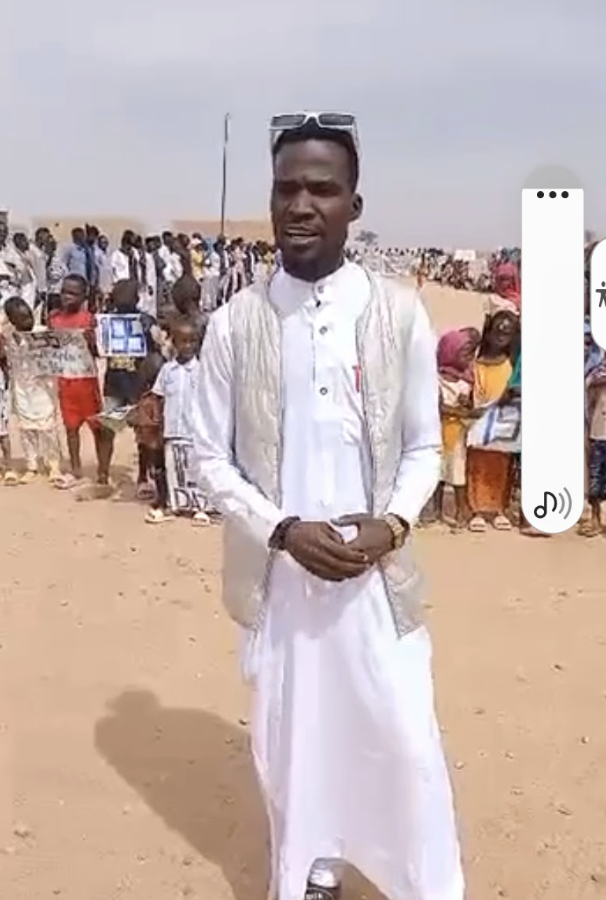
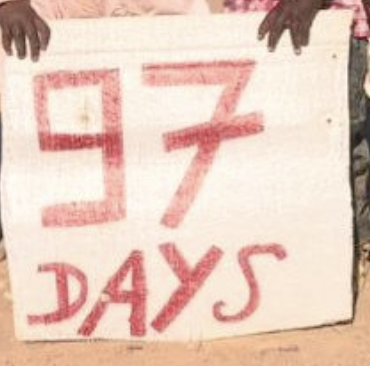
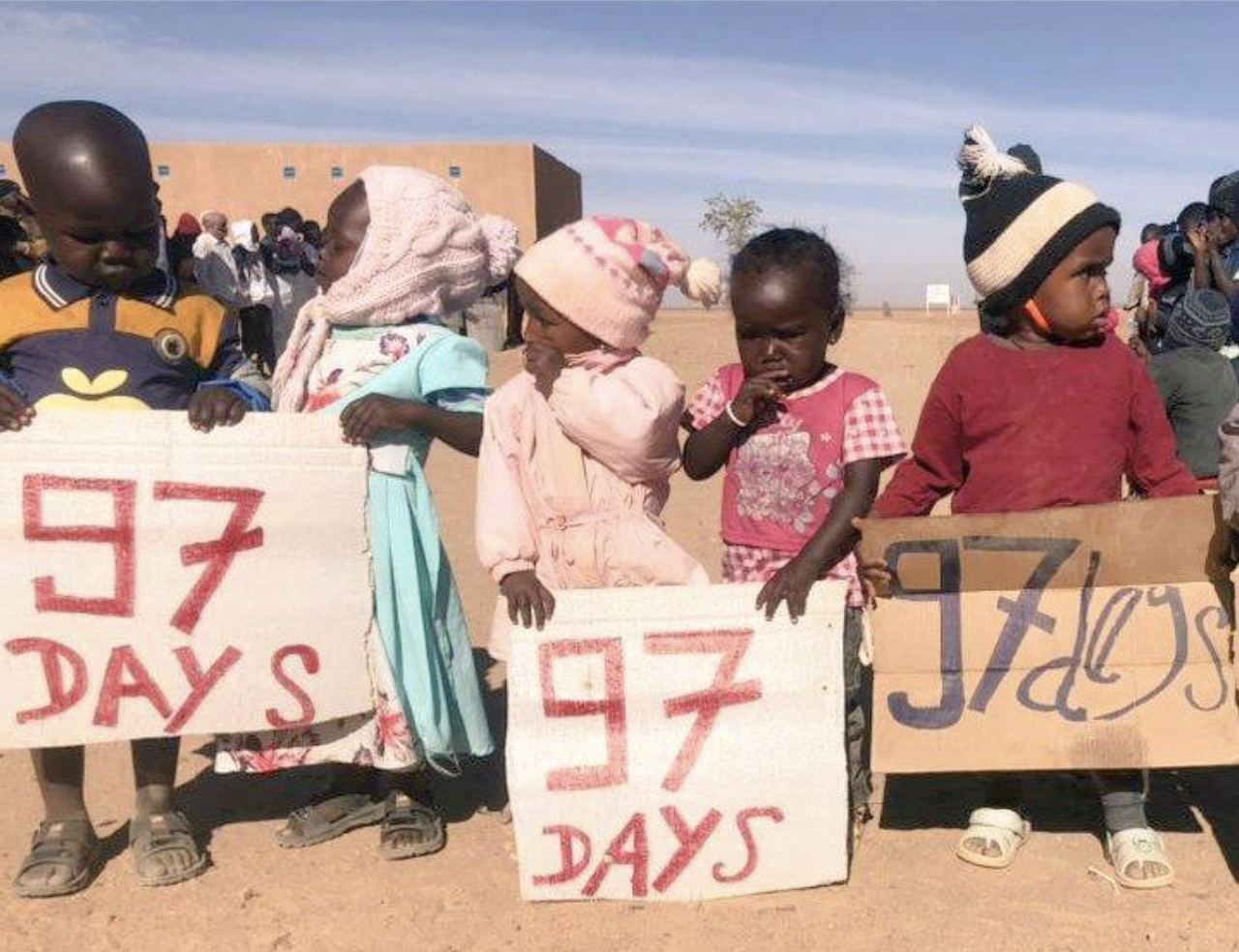
Voices from UNHCR camp in Agadez

1 / 4

conversation, 02.04.2025

Until now, there is no clarification regarding the detained refugees. The situation is very difficult. We are worried about them and we will continue our peaceful protest. We demand from all concerned parties that we do not want to stay here.

RiL: We are following the situation. An open letter to the UNHCR signed by many organization is circulating and will soon be published. Keep your moral high and please keep us informed!

We are confident that things will be okay one day.

RiL: Together we can!

certainly

Although weakened by physical and social circumstances, people courageously try to get together to organize and fight in order to change their condition and mobilize European public opinion. We proudly amplify their voices

Donate!